
In focus: 2024 Course Information

2024 Course Information
| Date | Task | Relevant To |
| 20 June | Course Info Sessions | Year 8, 9, 10 and 11 students |
| 21 June | VET Indicative Google Form | Any student interested in continuing/undertaking VET in 2024 |
| 23 June | Vocational Program Applications Due | Year 9, 10, 11 students interested in 2024 Year 10 Voc Prep, Year 11 VCE VM and Year 12 VCE VM |
| 23 June | Acceleration Applications Due | Year 9, 10, 11 students interested in 2024 acceleration |
| 11 July | Web preferences initial selections open | Year 8, 9, 10 and 11 students |
| 11 July | Interview bookings open | Year 9 and 10 students and their parent/guardian |
| 14 July | Approval letters forwarded to students (acceleration and vocational) | Year 8, 9, 10 and 11 students who have submitted an application for acceleration or vocational programs |
| 18 July | Interview bookings close | Year 9 and 10 students and their parent/guardian |
| 19 July | Web preferences initial selections due | Year 8, 9, 10 and 11 students |
2 & 3 August 2:20 – 6pm | Year 9 2023 to Year 10 2024 Interviews – final preferences submitted as part of the individual interview | All Year 9 students and their parent/guardian |
7 & 9 August 2:20 – 6pm | Year 10 2023 to Year 11 2024 Interviews – final preferences submitted as part of the individual interview | All Year 10 students and their parent/guardian |
| 11 August | Year 8 and Year 11 final preferences due | Year 8 and 11 students |
- Year 8, 9, 10 and 11 students will participate in a Course Information Session on 20 June. Students in Year 9, 10 and 11 will also have the opportunity to attend a Learning Areas Expo on the day to access information relating to their program and elective choices.
- Year 11 and 12 students received Course/Tertiary information via TIS on 17 May.
- The 2024 MSCW Course Guide is still being finalised and will be available on Simon very shortly to aid informed decision-making. The 2023 MSCW Course Guide can be used in the interim, but will not contain the most up-to-date details for new offerings and VCE study design changes.
- Applications for Acceleration are available to students on Simon > Student Academic Information. Links to application details and forms will be in the Course Guide.
- Applications for Vocational Learning Programs are available to students via collection at the Learning Area Expo (see above). Links to application details and forms will be in the Course Guide.
- Any student in Year 9, 10 or 11 planning on continuing/undertaking VET (TAFE) studies in 2024 are required to provide an indication of this via a simple Google form. Please complete before Wednesday, 21 June.
Helpful career strategies we’ve been talking about lately
- Traffic Light Strategy, is a preference/ranking system which is great for decision-making relating to a preferred school program and elective choices, but could easily be adapted to post-school options and further study interest areas.
- Informational Interview, is an informal meeting (via phone, virtually or in person) between a person seeking further information about a particular job, career or industry and a person already established in that field of work.
Pathways and programs at MSCW
At Marist-Sion College the following summary outlines key details of programs at each year level:
Year 7 and Year 8: Prescribed program incorporating Victorian Curriculum covering a range of learning areas and capabilities.
Year 9: Program incorporating prescribed studies and two Year 9 electives per semester. Year 9s with an interest and passion for practical and hands-on learning, and possibly a Vocational program in Year 10 and beyond, are encouraged to find out more about the Year 9 Trade Pathways Program via the MSCW Course Guide. This opportunity will require an application due end of Term 3. Initial expressions of interest can be emailed to Mrs Elly Martin.
Year 10
Choose one
- Standard Program, including core studies and three semester length electives.
- Vocational Preparation Program, including core studies, two semester length electives and a VET program.
- Languages Program, including core studies, two semester length electives and Language – Japanese.
- Accelerated Program, including core studies, two semester length electives and Unit 1 and 2 approved VCE study.
- Accelerated/Languages Program, including core studies, Unit 1 and 2 approved VCE study and Language – Japanese.
Year 11 and 12
To achieve a senior certificate qualification is a minimum two-year commitment in which students can undertake
- Victorian Certificate of Education (VCE) which at MSCW involves twelve VCE Units at Unit 1 and Unit 2 level including 2 units of Religious Education studied in Year 11 and five Unit 3 and 4 subjects studied in Year 12, plus one unit of Religious Education if not taking Unit 3 and 4 Religion and Society.
- VCE with Acceleration, where eligible Year 11 students will study a Unit 3 and 4 subject in Year 11. In Year 12, Accelerated students can opt to study an additional Unit 3 and 4 subject or commence a Higher Education study (start uni course unit/s)
- VCE with a VET program, which involves replacing one VCE study with an approved Vocational Education and Training (VET) program.
- VCE with Vocational Major (VCE with VM) includes school based VCE VM units, a VET program and work placement.
Please note: Students interested in Acceleration or a Vocational Learning Program are required to apply for a place in this program
Key resources to assist with decision making:
- Students will be provided with a Traffic Light Strategy Worksheet.
- Marist-Sion College Course Guide and linked resources including Course Information Presentations and relevant application forms.
- Year 9 – 12 students have access to Morrisby and should utilise this resource to aid decision making via the My Choices tab in their individual account www.morrisby.com (students can also provide Parent Access).
- VCAA website especially for information on VCE Studies, VCE with VM, Higher Education and Get VET and Where to Now Guide www.vcaa.vic.edu.au/
- VTAC website especially if interested in learning about Victorian tertiary courses and pre-requisites www.vtac.edu.au or Course Seeker if open to exploring tertiary options nationally www.courseseeker.edu.au
- My Skills website especially if interested in VET opportunities during and after school www.myskills.gov.au
- My Future website especially the Career Bullseye section if students have a particular subject that they enjoy www.myfuture.edu.au
- National Skills Commission Labour Market Insights website for general careers and pathways research https://labourmarketinsights.gov.au/
- Your Career for general careers and pathways research www.yourcareer.gov.au
- 2023 CEAV Resource Pathways https://ceav.vic.edu.au/media/252898/pathways-for-education-training-employment-animation.mp4
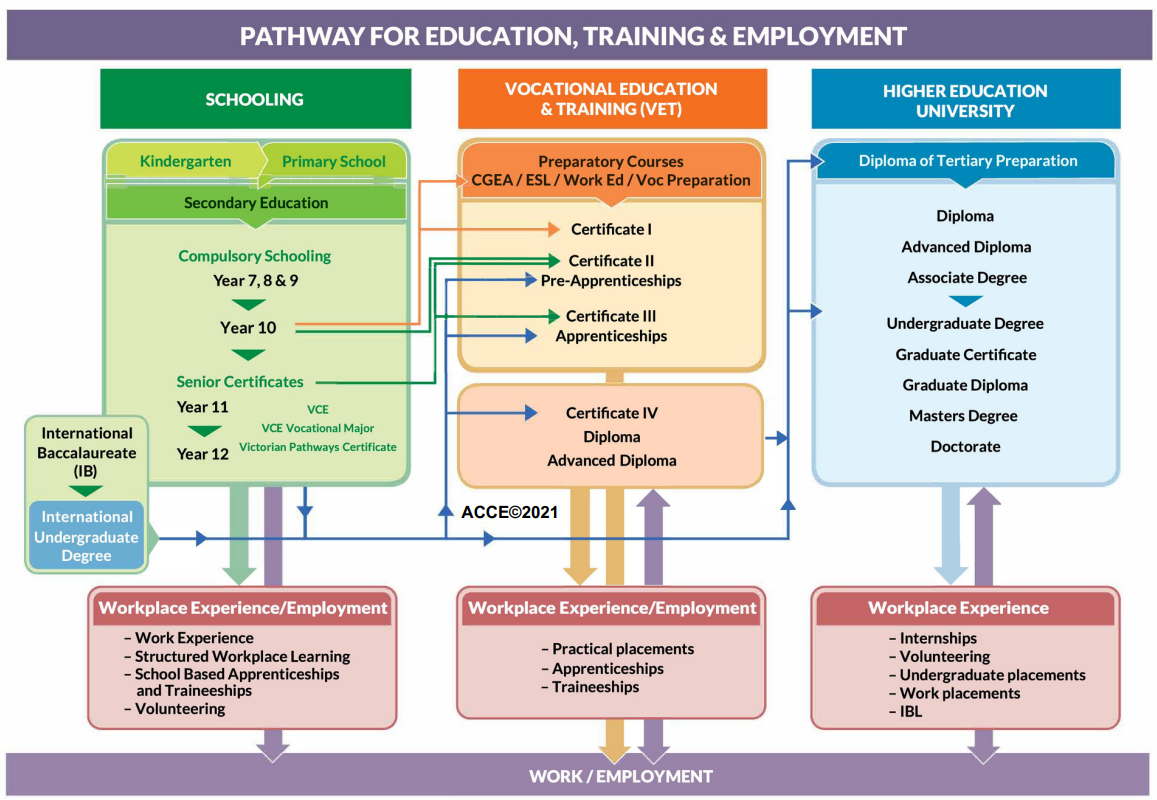
Info to assist School Leavers and Current Year 12s
National Careers Institute School Leavers Kit and Information Service
To support young people as they prepare to leave school, the School Leavers Information Kit and the School Leavers Information Service provide tailored careers information to help young people understand their education, training and work pathways. More info https://yourcareer.gov.au/
What’s the Difference between an Apprenticeship and Traineeship?
Both apprenticeships and traineeships offer a structured pathway into a career of choice via a model which combines on-the-job training and formal learning via a connected VET program. However, there are three key differences – range of occupations, completion time and legal requirements.
Range of Occupations
While traineeships are available on a broad range of occupations, apprenticeships are offered on skilled trades only.
Completion Time
Apprenticeships are a full-time commitment and are awarded after a fixed period of time. For example, an Electrical Apprenticeship will generally take four years, however this can be shortened by up to 6 months, depending on circumstances. Traineeships can be full-time or part-time. Because traineeships are competency-based, completion is dependent on achieving and demonstrating a level of competency in all the required modules. In general, a traineeship is usually completed within one to two years, but it may take more or less time depending on the role, employee and number of hours worked.
Legal Requirements
When a student signs up for an apprenticeship, the level of commitment made by both themselves and their employer is different to a traineeship. As an apprentice, upon signing the contract, their employer is committing to employ the student for the full term of their apprenticeship – and if they sell the business while the apprentice is working towards completion, the new owner must continue with the training contract. After the probationary period is up (usually 90 days) the contract can be cancelled, but all parties (apprentice and employer) must agree.
As a trainee, the employer must keep the trainee on for the term of their traineeship, however, either party can cancel the contract before it’s complete (mutual agreement is not needed). In addition, if the business is sold, the new owners are not obliged to continue your employment.
Understand the Differences Before You Commit
Both apprenticeships and traineeships provide a fantastic way to learn on the job – and as an added bonus, you receive a recognised qualification and get paid for your work too! So, when weighing up the two, it is important to consider the field one wishes to pursue, how long they are ready to commit to it, and what the legal implications are.
Find out more at NECA Education - Apprenticeships and Traineeships
Additional Apprenticeship and Traineeship Resources
- Australian Apprenticeship Pathways: You will be able to undertake apprenticeship aptitude tests, find local apprenticeship and group training centres, and learn about different trade occupations, www.aapathways.com.au/
- Australian Apprenticeships Pathways has developed a fantastic 4-step process for students to follow when seeking an apprenticeship or traineeship, http://bit.ly/39yUYmQ
- My Skills: You can search for and explore vocational courses across Australia, learn about in demand jobs and watch videos of young people who have completed vocational training, http://bit.ly/1D8uek7
- The Traineeship Guide (attached): includes everything you need to know about traineeships, including myths and facts, benefits, industries you can do a traineeship in, trainee videos, interviews and more.
Tertiary Options
State-based Tertiary Admission Centres process course applications on behalf of universities, some TAFE institutes, and some private providers.
You can research courses, prerequisites, selection criteria and ATAR profiles for the previous year’s intake.
Victoria www.vtac.edu.au
NSW & ACT www.uac.edu.au
QLD www.qtac.edu.au
SA & NT www.satac.edu.au
Tasmania www.utas.edu.au
Australia wide search
TAFE Options
MySkills is the national directory of vocational education (VET) organisations and courses.
Keep an eye on the Job Trainer and Free TAFE options which may continue into next year.
TAFE Gippsland – How old to you have to be to study at TAFE?
Possible school leavers are encouraged to check the attached poster from TAFE Gippsland, which outlines some clear age limits associated with accessing TAFE.