
Year 3 Term 1 Newsletter

Meet the teaching team
3A - Kate Burman (PLC Leader)
3B - Emma Cecil (alternate Mondays, Tuesday, Wednesday)
- Lauren Harris (alternate Mondays, Thursday, Friday)
3C - Bec Taylor
Welcome to Term 1
Welcome to Year 3 and 2026!
We have been delighted with how the children have settled into their new classes. We have all enjoyed getting to know each other through the beginning of the year
activities.
Specialist Timetable
Specialist timetable | 3A | 3B | 3C | |
|---|---|---|---|---|
| Italian (Stella Mondy) | Mon | Mon | Mon | |
| Music (Sue Digby) | Mon | Mon | Mon | |
| Science (Louise Slann) | Tues | Wed | Wed | |
| PE (Bec Robinson) | Wed | Wed | Tues | |
| Art (Suzanne Reid) | Wed | Thurs | Wed | |
| Library | Tues | Tues | Tues |
Important Dates
17/02: Whole School Photo Day
23/02: Curriculum Day - Student free day
27/02: Community picnic
09/03: Labour Day - Public Holiday
11/03 - 23/03: NAPLAN testing
27/03: Y3-6 House Cross Country
04/04: Last Day of Term- 2:30 dismissal
Electronic Rolls
Our electronic rolls are legal documents therefore we must be accountable for any absences. Please assist with this by informing the school by replying to the text message sent by Compass in the event of your child being away.
Teaching and Learning
English
Reading
Students will read for enjoyment and participate in activities to improve their ability to decode and comprehend texts. They will consolidate their knowledge of sounds (phonemes) of less common combinations of letters (graphemes) e.g. ph, wr, and practise different strategies to read and spell more complex words. In comprehension sessions, students will be exposed to a range of different text types and will be explicitly taught to self monitoring for meaning, identify text features, identify facts and details and make simple inferences. They will develop their reading fluency and be exposed to new language to expand their vocabulary.
Writing
Students will focus on the typical structure of narrative and persuasive text types. They will be supported in generating ideas and be explicitly taught how to create a plan to help them organise their ideas to fit the required structure for each genre. They will practise referring to their plan when writing. Students will also consolidate their knowledge and skills in structuring simple and compound sentences and will be taught how these sentences can be used and developed, using different writing strategies, to engage the reader. Students will be supported in developing skills to reread and edit their work for structure, grammar, spelling and punctuation to clarify meaning. As part of our study of English Orthography, students will investigate how the written word works.
Speaking & Listening
Through a range of activities, across all areas of the curriculum, students will listen for
key points in discussions. They will be supporting in actively contributing to
class, small group and paired conversations, varying language according to context. Using our class texts as a springboard, they will be encouraged to share and justify their thoughts and ideas about the characters and events. They will also have opportunities to present their completed work to the class.
Mathematics
In Term 1, our lessons will have a strong emphasis on Number and Algebra topics, starting with the fundamental concept of place value, before moving on to addition and subtraction. Work samples and assessments will be used to build on what the students already know and students will be supported to develop their ability to set and work towards achieving their own maths goals. Maths games at the start of the lesson aim to build speed and accuracy with counting and recalling single-digit addition and subtraction facts. Students will have access to Mathletics to support their learning. At the end of the term, students will develop knowledge and skills to read time to the nearest minute on analogue and digital clocks.
As part of each unit of work students will be supported in reading worded problems and exposing the key information that will allow them to solve the problem. They will make connections between different concepts, employ a range of strategies to solve the problem and justify their reasoning using mathematical language. The problems will be challenging and students will learn to be comfortable with struggle.
Humanities
This term in Civics and Citizenship, students will explore what it means to belong to a community and why rules, laws and responsibilities are important for fairness and safety. Using the 2026 Winter Olympics as a real-world context, students will consider the guiding question: How do rules and responsibilities help communities work well together? Students will learn about communities such as the Olympic Village and make connections to their own communities, including school, sports teams and local groups. The unit culminates in a project where students will design and present rules, laws and responsibilities for a community, place or activity of their choice.
Wellbeing
CEPS VALUES
COURTESY RESPECT CO-OPERATION RESPONSIBILITY
In our first few weeks of Year 3, students have spent time discussing our school values and what they look like in our classrooms and around the school. This term our CEPS Value is focusing on Courtesy. Students will engage in Wellbeing Sessions that will involve exploring and discussing what it means to be courteous at school and in their everyday life.
During our Wellbeing sessions, students will also participate in Respectful Relationships education which will focus on supporting their social and emotional skills and promote positive and personal growth. Term 1 will focus particularly on identifying personal strengths and emotional literacy and students will engage in age-appropriate discussions, stories and activities to explore these topics.
We will continue to give out weekly awards at our fortnightly Friday afternoon assembly to students who have displayed the CEPS values.
Your child may also receive a CEPS raffle ticket for displaying the school values! Award winners will be drawn and announced during assembly on Friday afternoons.
Supporting learning from home
Read. Support your child in developing a habit of reading for a minimum of 15 minutes every night. They can: read aloud to develop fluency and expression; be read to; participate in shared reading of a book. Discuss what they have read so they can practise their comprehension skills. Become a member of the Kingston libraries; they have an amazing collection of books - something for everyone.
Maths. Practise counting forwards and backwards from any three digit number by 1’s, 2’s, 5’s and 10’s to develop accuracy and fluency. Play games to develop the automatic recall of addition and subtraction facts. Provide your child with incidental opportunities to read a clock and calculate elapsed time, use measurement when building and cooking, calculate change when shopping; these are all great opportunities to support mathematical understanding. Complete the assigned activities on Mathletics.
Writing. Provide opportunities for children to engage in meaningful writing, for example send an email to a loved one, write a persuasive letter for that toy they really want, write a shopping list or write a card for a friend. For those who want to, encourage them to create books with their own stories or design a comic.
Homework: In Year 3 Homework is expect to be daily reading routines and completion of assigned Mathletics tasks. From time-to-time there will also be tasks provided to consolidate classroom learning. e.g. Writing /Handwriting / English Orthography.
Term 1 Additional Information
Headphones
Most students have brought a pair of head phones to school primarily to use during NAPLAN testing. If they haven't already, your child can still bring their own set of headphones to school. Please ensure that you label them and that they have a jack. Bluetooth headphones are not suitable our school technology. We do have some spare headphones in our classrooms which your child can use if they do not have a personal set.
NAPLAN
NAPLAN, which stands for The National Assessment Program - Literacy and Numeracy, is a standardised set of tests that are sat by students in years 3, 5, 7 and 9. The results give parents and schools an idea of where each child is at in their development, and help education bodies identify areas of the curriculum that need specific focus.
This year NAPLAN will be held from 13-21 March. More information about the specific testing schedule will be provided soon. More information for parents and carers is available at;
https://www.nap.edu.au/docs/default-source/naplan/naplan-information-brochure-for-parents-and-carers.pdf?sfvrsn=2551405e_14
Please speak with your teacher if you have any questions.
Communication
You are welcome to contact your classroom teacher via email through Compass. Whilst families are navigating the transition to Compass, we are also still using Dojo for messages between parents and teachers at this stage. This is likely to be phased out at some stage this year. We are also still currently using Dojo to share learning updates from our classrooms.
With that said, you are always more than welcome to pop into the classroom before or after school if you have any queries or concerns.
Whilst we endeavour to get back to you promptly, please understand that we are often unable to check these messages until after 3:30pm. If you need an important message to be passed on to your child, we ask that you communicate this via the office (e.g. to advise that your child will be collected early or by another family member). The office will then pass the message on to your child's classroom teacher.
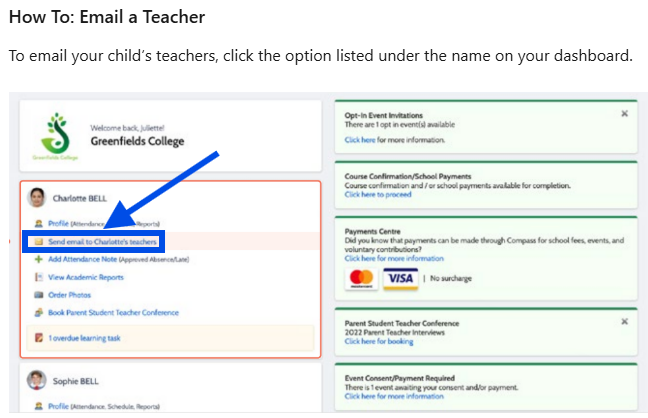

Compass: Compass is the formal tool for communication regarding attendance, payments, excursions, camps, permission forms, school reports, etc.
Please use Compass to advise the school in a timely manner of all student absences.
Early Pick Up: If you need to pick up your child early, please collect them from the office area and be sure to sign them out. You will require an Early Leaver's Pass, provided by the office staff, before we are able to dismiss students.
You can also keep up-to-date by using the school website and weekly newsletters: http://www.cheltenhameast.vic.edu.au