
In focus: Alternative Options and Pathways

“Career development is not point-in-time decision-making to choose one’s path for life. It is a lifelong collaborative learning quest, supported by coaches, loved ones, friends, and allies, to construct our best possible future. It is a quest to be the most and happiest we can be while being ready to adapt to the good and bad that blind-side us throughout life.” A quote from an interesting article Re-imaging education through a career development lens
With above quote in mind, what would you like to try next?
The most common post-school options include employment, traineeship or apprenticeship, productive gap year, volunteering or further study, possibly at TAFE or university. And depending on the student, a career action plan may make reference to some or all of these as possible options. With good reason too! Approximately one third of people who pursue further study withdraw or make changes to where or what they study. While almost half of those commencing apprenticeships or traineeships cease or make changes. And research suggests we can expect to have around 17 employers across our career. To be brief, it is normal and very common to be unsure about what you want to try after your current role, in this case as a secondary school student. Making use of all your resources and having options on the back of good research and planning will be helpful for a rewarding future.
The following provides ideas possible for alternative options relating to further study.
Options could be built on the basis of course and entry requirements; level of qualification, time frame and job outcomes; or closely associated professions. Take for example this Pathways Diagram relating to the role of a Primary Teacher from the MyFuture School to Work Pathways Infographics which depicts a traditional more direct pathway and two alternatives.
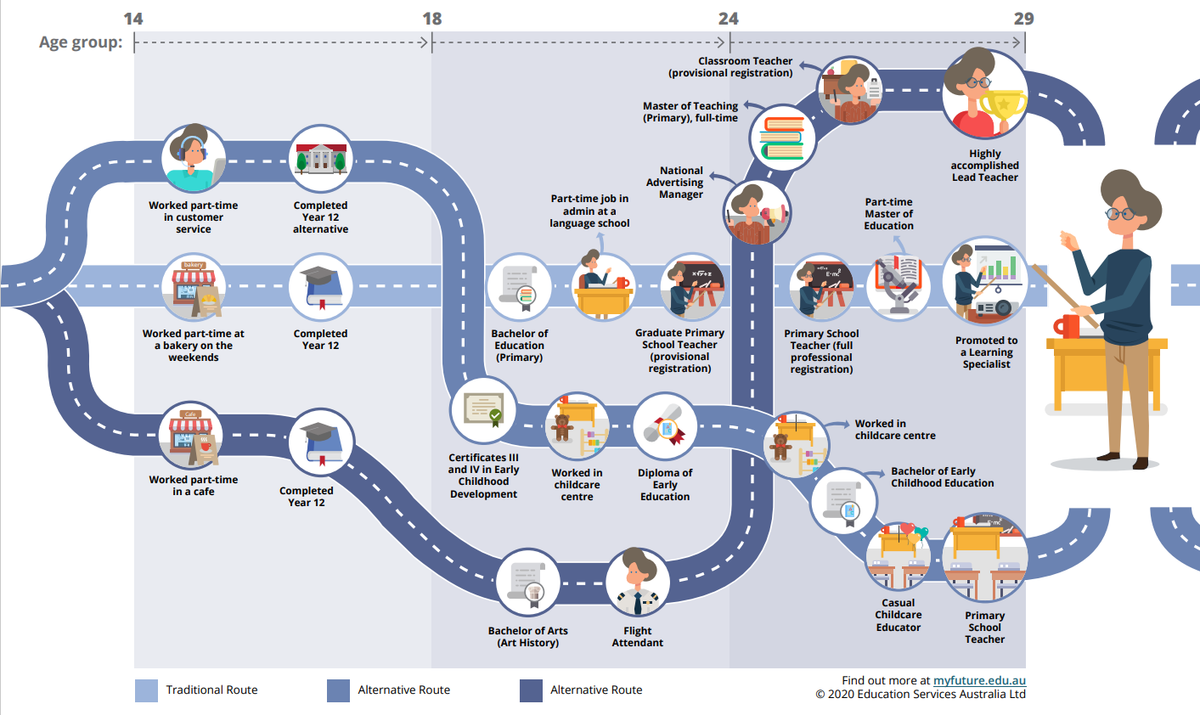
There are so many options and permeations in careers and pathways that this is difficult to represent, but hopefully the following provide relevant examples to demonstrate alternatives where Plan A might be considered ‘best case’ and Plan B, C and D could reflect back up options:
- Course and Entry requirements
When comparing courses, check details like qualification, majors, units, length, accreditation, etc. very carefully and choose the courses that best meet your needs and interests.
If you are unsure, consider a general rather than specialised course or look for one with flexibility.
Also note, that ATAR is not a requirement, nor does it reflect the quality of the course, it is just a guide as to the degree of competition associated with entry into a course.
| Plan A – Bachelor of Commerce at Monash University | Plan B – Bachelor of Commerce at Deakin University | Plan C – Bachelor of Commerce at ACU |
Pre-reqs: 25 in English, 25 in one of Maths: Mathematical Methods or Specialist Mathematics 2022 Lowest Selection Rank: 86.75 | Pre-reqs: 20 in English 2023 Lowest Selection Rank: 80 (Melb)
| Pre-reqs: 25 in English 2023 Lowest Selection Rank: 61.10 |
- Level of qualification
When comparing qualification level and associated jobs, use reputable industry organisations and government websites. Recent entrants/graduates to the industry or job can also be a helpful source of information.
| Plan A – Kindergarten Teacher | Plan B – Outside School Hours Coordinator, Childcare centre manager | Plan C – Pre-school, Childhood educator assistant, Childcare worker | Plan D – Traineeship with Early Learning Centre or Kindergarten |
Requires a Bachelor of Early Learning Time frame: typically 3-4 years Pre-reqs: Typically English plus may require satisfactory completion of Unit 1 and 2 General Maths Initial Teacher Entry Reqs also include min. ATAR of 70 and completion of a suitability test (most commonly CASPer) 2023 Lowest Selection Rank: Varies, but will have to be 70+ (adjustments are permitted) | Diploma of School Age Education and Care or Diploma Of Early Childhood Education and Care Time frame: 21months average course duration Pre-reqs: WWC ATAR is NA Currently a Free TAFE course which can attract credit towards higher level study | Certificate III in Early Childhood Education and Care Time frame: 47weeks average course duration Pre-reqs: WWC ATAR is NA Currently a Free TAFE course which can attract credit towards higher level study | Certificate III in Early Childhood Education and Care or Certificate III in Education Support Time frame: 24months (FT nominal) Great way to secure an entry level position and build familiarity, greater certainty and employability. May also attract credit towards higher level study.
|
- Closely associated professions
When comparing associated professions students may like to consider resources like Job Outlook https://joboutlook.gov.au/, Morrisby, My Future, and The Good Career Guide. These sources can help guide job prospects, additional study or placement requirements, pay, gender ratios, closely associated or linked roles, etc.
| Plan A – Physiotherapy | Plan B – Occupational Therapy | Plan C - Osteopathy | Plan D – Massage Therapist |
Overview: Physiotherapists assess, treat and prevent disorders in human movement caused by injury and disease. Course Example: Monash Uni’s Bachelor of Physiotherapy (Honours) Pre-reqs: 30 in English, 25 in two of Biology, Chemistry, Physics, Math Methods or Specialist Maths 2023 Lowest Selection Rank: 97.10 | Overview: Occupational therapists assess and treat people who, due to illness, injury or circumstance, are limited in their ability to undertake everyday activities. They assist people to regain lost functions, develop their abilities and social skills, as well as maintain and promote independence in their everyday lives to enhance health and wellbeing. Course Example: Federation Uni’s Bachelor of Occupational Therapy (Honours) Pre-reqs: 25 in English, Units 1 and 2 of General, Methods or Specialist Maths; Units 3 and 4: one of Biology, Chemistry, Health & Human Development, Mathematics, Physical Education or Physics. 2023 Lowest Selection Rank: 58.15 | Overview: Osteopaths diagnose, treat and provide preventative advice about disorders that affect the body's musculoskeletal system, using manual techniques to alleviate stresses and dysfunction to improve the body's function Course Example: Vic Uni’s Bachelor of Science (Osteopathy)/Master of Health Science (Osteopathy) Pre-reqs: 20 in English and 20 in one of Biology, Chemistry, any Mathematics or Physics 2023 Lowest Selection Rank: 62.30 | Overview: perform therapeutic massage and administer body treatments for health, fitness and remedial purposes. Course Example: RMIT’s Diploma of Remedial Massage. Pre-reqs: None Provides a pathway into Myotherapy. 2022 Lowest Selection Rank: NA |
Alternative pathways to higher education
If you are considering university studies but think that you won't qualify for entry, there are a range of support programs and different pathways available to you. See MyFuture Career Insights https://myfuture.edu.au/career-insight/details?id=alternative-pathways-to-higher-education#/
The attached documents from Compass Career News Pathways Courses and Programs to University, might also provide a guide for students exploring alternative pathways for 2024.
Apprenticeships and Traineeships
An entry level position which combines on-the-job experience and a formally recognized VET qualification.
Check out: AAPathways
Volunteering
Looks so good on a resume! And a great skills and networking builder. Check out:
- https://www.volunteeringvictoria.org.au/
- https://govolunteer.com.au/
- https://www.australianvolunteers.com/
Gap Year
A ‘productive gap year’ can be great value-add to your overall journey, especially if you undertake opportunities which see you develop personal, work and travel skills that employers look for.
Study, Work, Grow has produced a handy Gap Year Guide which takes an in-depth look at what a Gap Year could mean for you, the benefits, the options and some of the important things you need to consider.