Banner Photo

Positive Behaviour for Learning
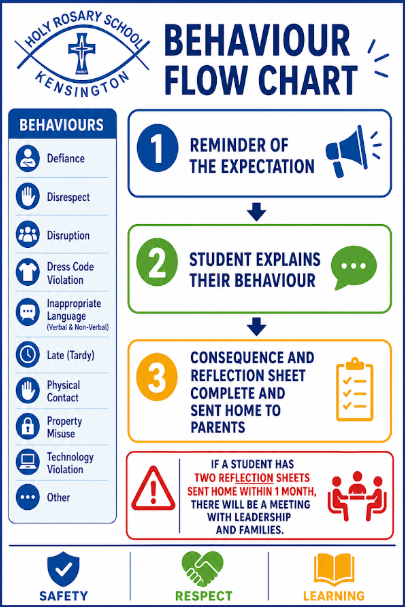
Students will be learning about our PBL Behaviour Flow Chart again this week, to help them further understand that the flow chart was developed to help everyone stay safe, respectful so that all students are ready to learn. Below you will find a copy of the Flow Chart that Holy Rosary staff and students will follow. 
Gallery Image

Every child has the right to learn and every teacher has the right to teach. 

        Lesson Plan: Holy Rosary’s Behaviour Flow Chart

Step 1: List Learning Intentions and Success Criteria


We are learning to :

  • understand our school's Behaviour Flow Chart and how it helps everyone stay safe, respectful, and ready to learn. 


It will look like:

  • explain why the Behaviour Flow Chart exists
  • identify the steps in the Behaviour Flow Chart
  • describe what happens if a behaviour concern occurs
  • connect the flow chart to Safety, Respect, and Learning
  • demonstrate appropriate ways to respond when given a reminder.


Step 2:  List a rationale for teaching the behaviour 

Why is it important?


Holy Rosary School Values: Relationships, Respect, Resilience, Integrity, Kindness.


Holy Rosary School Expectations: Safety is our right. Learning is our responsibility. Respect is our way. 


Step 3:  Identify examples and non-examples of the desired behaviour 

What would the behaviour look/sound like?                      

Examples

  • Following the school expectations
  • Seeking help from a trusted adult if there is conflict that can’t be resolved by students 
  • Repairing harm to a relationship 
  • Being safe in the classroom and out on the yard 
  • Following teachers instructions 
  • Using learning time productively 


Using school equipment safely and respectfully 


What would the behaviour not look/sound like?

Non-examples

  • Not following directions right away
  • Using unkind words, actions, or body language
  • Distracting self or others during learning time
  • Wearing clothing outside the school uniform
  • Using inappropriate language or gestures
  • Arriving late to class
  • Invading others’ personal space
  • Misusing school, personal property or technology
  • Repeated refusal to follow expectations
  • Cheating or stealing 
  • Bullying or harassment
  • Physical contact
  • Dishonesty


Gallery Image


Michaela, Student Wellbeing Leader