
Glen Education Aspendale North
Earth Day Project
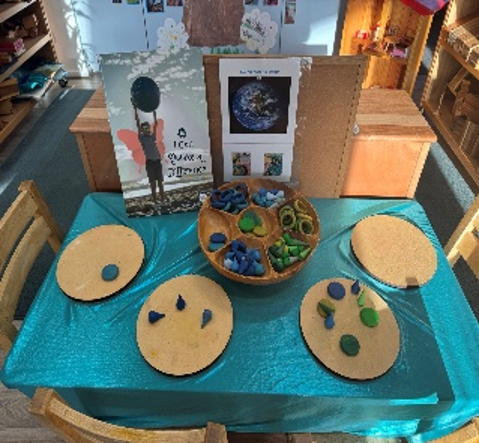
To begin our celebration, the children were invited to create their own ‘Earth’ using gems and Grapat pieces. As they selected colours and arranged the materials into circles, oceans and land, we noticed careful decision-making, collaboration, and a growing sense of connection to our planet. Children shared ideas with one another such as “This part is the water” and “We need green for the trees,” demonstrating emerging understandings about Earth’s features and what lives here.
We also set up a tuff tray experience using a beach theme including ocean animals and shells in the sand, we then placed various items such as buttons, scraps and materials amongst the ocean set up. We also placed tongs and buckets and asked children to “clean up” the beach to keep it safe for the animals and for our earth.
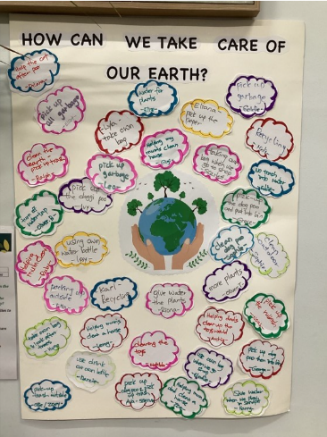
At group time, we gathered to talk about why Earth Day is important and how we can help care for the world around us. The children asked many thoughtful questions, including “What happens if we leave rubbish on the ground?”, “Where does the rubbish go?”, and “How do we keep the ocean clean?” Together we discussed caring actions such as reducing waste, reusing materials, recycling, and being kind to living things. Children listened closely, built on each other’s ideas, and showed curiosity about how everyday choices can make a difference.
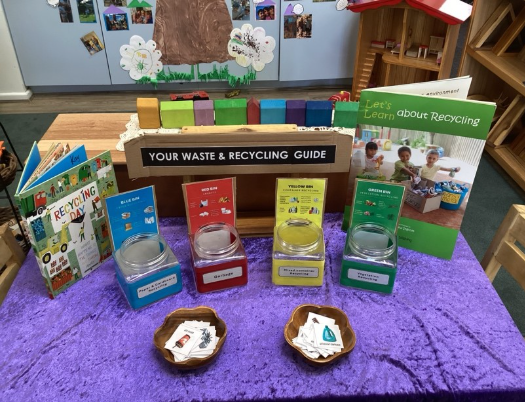
To extend our conversation, we created waste-sorting bins and invited the children to sort different items into the correct bin (general waste, recycling, and food scraps/compost). As they examined each item, children paused to think, negotiated with friends, and explained their reasoning: “Paper goes in recycling,” “This banana peel can go in compost,” and “This one can’t be recycled.” This hands-on experience prompted even more questions highlighting their growing awareness of sustainability and a desire to understand real-world systems.
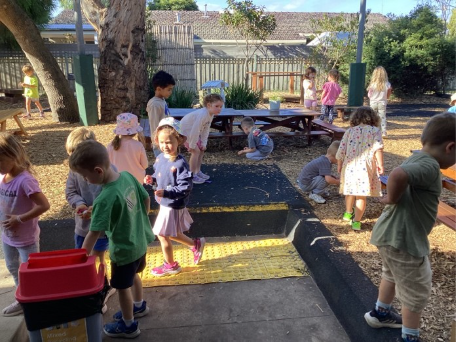
Finally, we invited the children to take action by helping to clean up rubbish outside. Equipped with gloves and buckets, they worked together to scan the environment, collect litter, and place it into the appropriate bins. Children showed pride in their efforts and encouraged one another “We’re helping the Earth!” This experience supported children to see themselves as capable contributors and reinforced that caring for our environment is something we can do every day.
Educator Reflections
Throughout the project, the children demonstrated strong curiosity and increasingly complex thinking about sustainability. The open-ended materials (gems and Grapat) supported creativity and representation, while the waste-sorting provocation encouraged problem-solving, classification, and scientific inquiry. The outdoor clean-up provided a meaningful opportunity for children to take collective responsibility and experience the impact of their actions on our shared spaces.
Learning Links (EYLF V2.0)
- Outcome 2: Children are connected with and contribute to their world—showing care, respect and responsibility for the environment and participating in sustainable practices.
- Outcome 3: Children have a strong sense of wellbeing—working together, taking safe action outdoors, and demonstrating confidence and persistence.
- Outcome 4: Children are confident and involved learners—investigating, questioning, sorting/classifying materials, and problem-solving collaboratively.
- Outcome 5: Children are effective communicators—sharing ideas, asking questions, and explaining their thinking to peers and educators.
Curriculum goals:
- Learn through play to experiment, investigate and explore ideas
- Develop interests and curiosity about their environment
Children’s Voice
“We need green for the trees.”
“If rubbish goes in the ocean the animals might eat it.”
“This goes in recycling—so we can use it again.”
“We’re helping the Earth!”
Next Steps
- Create a recycling investigation table with common items from lunchboxes and the classroom, and research (with children) which items can be recycled locally.
- Set up a compost/worm farm experience and track what food scraps can be added, noticing changes over time.
- Introduce a “reduce and reuse” makerspace using loose parts and recycled materials to create new inventions.
- Continue outdoor environmental care routines (mini clean-ups, watering plants, caring for the garden) and encourage children to suggest new caring actions.