At Glen Education Glover Street Kindergarten, the Paddock to Plate yearly inquiry project is deeply embedded in the service’s educational program and daily practice, forming a consistent, whole-service approach to learning. It goes beyond a one-off gardening or cooking activity. It is a sustained, evolving inquiry integrated across all learning areas and routines.
These activities are intentionally planned and embedded into the weekly curriculum, transitions, and real-life learning experiences.
Children play an active role in every step of the paddock to plate process. They make the decision of what vegetables they would like to grow, help plant and care for the vegetables, observe and document plant growth, harvest fresh produce and use it to prepare simple but nutritious meals. Families and the wider community contribute by sharing gardening tips, donating resources, and taking part in cooking activities, strengthening the connection between home, kindergarten, and the environment. These activities are intentionally planned and embedded into the weekly curriculum, transitions, and real-life learning experiences.
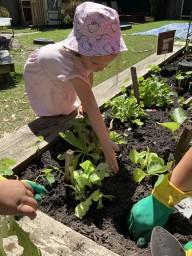
After a discussion with the children at the start of the year, we decided to plant a variety of lettuce, silver beet, eggplant, corn, carrots, spring onion, strawberries and a mix of herbs. Children worked together to clean the garden beds and top them up with fresh soil. As the children potted the plants, it opened learning opportunities for children to observe the roots of the plants, their texture and patterns. One of the children shared “roots will grow underground and help them be strong”.
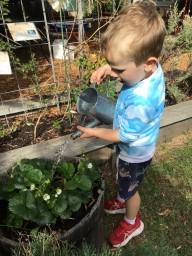
Through previous knowledge and researching by reading books, children helped to make a list of things that our garden beds need to stay healthy; dirt, soil, water and sunshine. Children have been active participants in looking after our garden. This is supported in our learning environment by providing access to watering cans and garden hoses, as well as gloves and shovels for children to tend to the garden. As the vegetables grow, children have been observing the changes in colour and size, as well as having the opportunity to taste various vegetables straight from the garden. Children have also been exploring the bug life in our garden, observing the holes in leaves and finding visitors such as green caterpillars and snails.
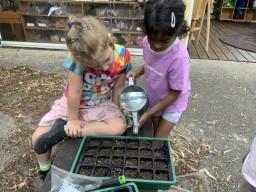
Our Paddock to Plate project is not defined by just growing vegetables. It has extended into branches of investigation and inquiry. It supports learning concepts such as science through creating a greenhouse to grow our own seedlings, numeracy through measuring ingredients and counting seeds and cultural awareness through sharing food traditions and knowledge, such as inviting families to help harvest the olives from our tree. The philosophy is aligned with the EYLF v2 learning outcomes and our service philosophy, particularly in fostering children’s sense of agency, responsibility and environmental sustainability.
One of the main interests so far has been the growth of our sunflowers. At the beginning of the year, we planted small sunflower seeds in one of our garden pots as requested by some of the children. Children demonstrated patience, watering the soil but not being able to see anything for many weeks. Slowly, the tiny seedlings began to pop their heads up through the dirt. Over the following weeks, the stems grew taller and taller. At last we could see the tops of the flowers beginning to form, a tiny green bulb on the end of each stem.
Every day it created wonder and excitement….when will the flowers pop out to say hello? Finally we began to see the beautiful yellow petals as the sunflowers glistened in the natural light.
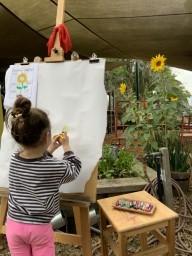
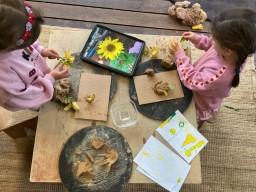
Children’s excitement, voices and interest was supported in our learning environment in many different ways. Drawing materials were added near the garden beds for children to draw their own sunflowers, some children decided to make a sunflower out of clay in our art studio, some children chose to take photos of the sunflowers, whilst others chose to investigate the process of the sunflower and the stages of the seed, to the seedling, to the flower itself. This aligns with our service curriculum goal; Children have the right to play, wonder, connect and celebrate learning.
The development and ongoing evolution of the Paddock to Plate project is underpinned by regular and meaningful critical reflection. Educators meet weekly to reflect on children’s engagement, learning outcomes, and emerging questions. They analyse how the project supports children’s wellbeing, identity, and understanding of sustainability. Through this process, the project has grown from a basic gardening activity into a comprehensive, multidisciplinary inquiry.
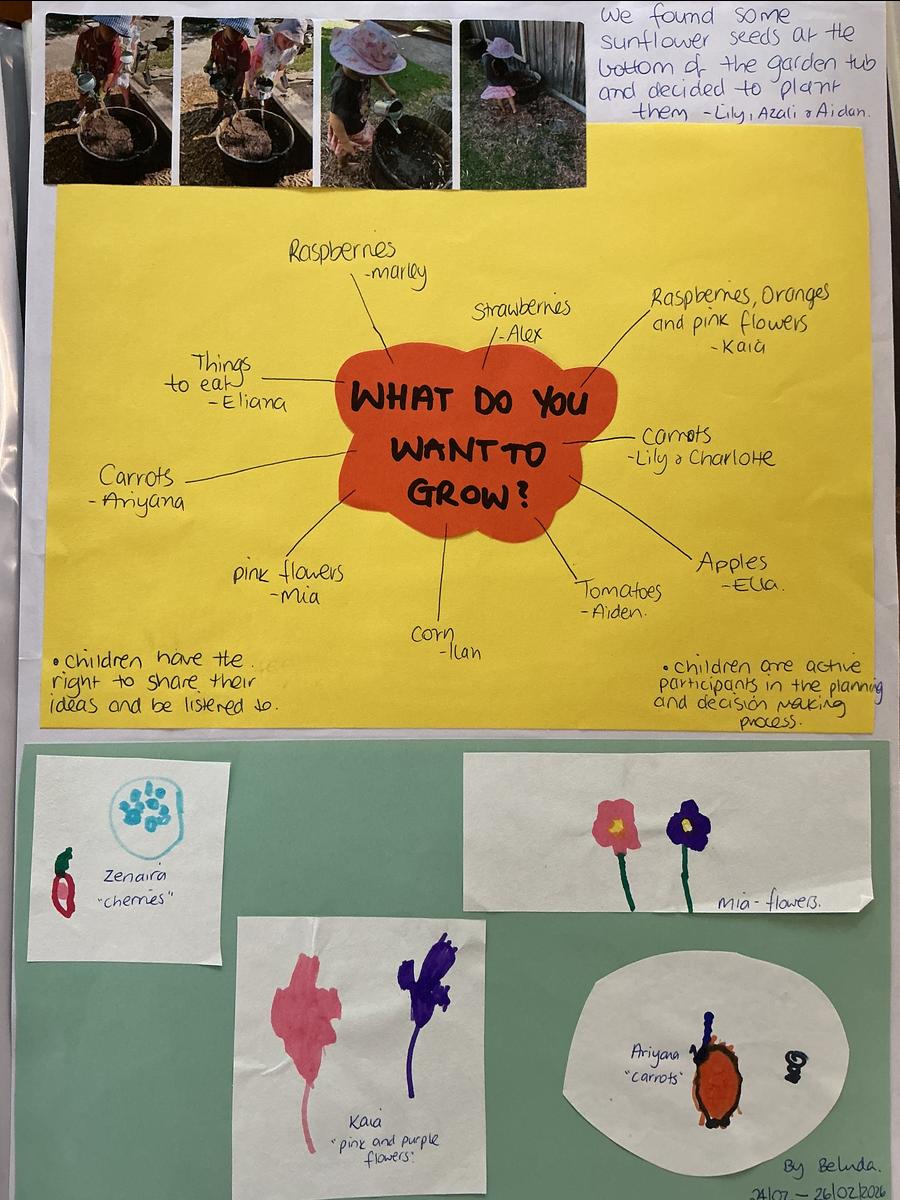
Aligning our practice with the VEYLDF Practice Principles, particularly Reflective Practice, we began to use a floor book as a space for sustained shared thinking. It now serves as a central reflective artefact where children’s questions, hypotheses, drawings, photos, annotations, and reflections are captured with genuine intentionality. Educators document not only what children are doing, but how they are thinking, problem-solving, and connecting their ideas, regularly returning to earlier pages to revisit and extend previous thinking.
The Paddock to Plate inquiry itself has been enriched through this change in the way we document learning.
This is not a predetermined project. It is a fluid, emergent investigation grounded in children’s curiosities about where their food comes from, sustainability, and ethical responsibility. The floor book captures the complexity of learning, the interrelated web of connections being made, and the growth in children’s critical and creative thinking.
This shift in documentation has also influenced our community. Families now engage more meaningfully with the inquiry, as the floor book invites them into a learning conversation with their child and educators. It fosters a shared narrative, where children’s voices are central. It’s meaningful to families as they can see the depth of research children and educators engage in together.