From the Principal
Dear Blue Mountains Grammar School Families,
I wonder if you are like me and some days feel as though the world has tilted off its axis. Absurd headlines give way to disturbing revelations, and the news cycle seems intent on numbing us rather than informing us. As someone who has already journeyed through the messy wonder of raising young children and teenagers, I often wonder: How would I have navigated this time if I were still parenting kids at home today?
Having said that, I do not think that this is a despairing newsletter piece. I would rather see it as a call to arms. Because when we step back and look at the arc of civilisations, the data suggest a sobering pattern and a hopeful counter‑move that a community like ours can make.
If you are parenting today, you carry twin responsibilities: protect your child’s inner life and apprentice them to the common good. That means staying engaged with difficult topics (even when you’d rather look away) and with your child as they encounter them online and at school.
Why is this essential? Because the research shows that societies become vulnerable when decision‑making is captured by the loudest megaphones and the thinnest elites. Countering that trend begins with media‑literate families who can spot skewed incentives, ask better questions, and take local action. That is a kind of micro‑democracy at the dinner table.
And a way to take back the narrative is to name the headlines plainly with your children, not as a deep dive into a shock-horror response, but as moral case studies: abuse of power, such as the Epstein files, public bigotry, homophobic, racist, and other degrading commentary, and the reality of street violence and hate. The point is not to marinate in outrage but to practice discernment and empathy and to keep asking: What, here, is mine to do; on my street, in my school, with my neighbours? That question alone shifts the story from doom to duty.
There is a growing body of research that has tested a long‑held belief that as societies get older and more complex, they can become more fragile. Using survival‑analysis across hundreds of past societies, researchers have found that the risk of societal decline drops steeply during the first two centuries before it levels off. This is noted as an “ageing effect”. The signs of this are like the things we recognise today: environmental degradation, widening inequality, and decision‑making skewed toward narrow elites. But the same researchers note a crucial footnote: some societies did pull through crises by reinventing themselves. Renewal, it seems, is possible.
More recent conversations among scientists highlight that technological solutions alone will not steady us. Real resilience will come from behavioural change, from how we relate to one another, from how communities support one another, and from how we choose to live locally with intention and care.
Across all this research, one truth stands out: Strong communities make societies stronger. If large systems struggle under their own weight, then the local level becomes even more important.
Strong neighbourhoods, schools, churches, clubs, and community groups can create the kind of social fabric that holds a society together. These small, everyday spaces are where trust grows. They are also where we learn how to talk to each other, share space, disagree without contempt, and help. If global systems feel strained, then the local becomes even more important. Our neighbourhoods, schools, churches, and family circles aren’t just social extras, but they are the places where trust is rebuilt, and hope is practised.
Your family is a micro neighbourhood, and a great place to start this work.
Our role is not to shield children from the truth, nor to drown them in it.
Our role is to walk alongside them, interpret the world with them, and model how thoughtful, compassionate people respond to the chaos without letting it harden their hearts.
And what does it mean for our community, both locally and more widely? Well, that might be simpler than we think. Many of life’s hardest challenges have a way of circling back to how we treat each other.
Even if someone has never read the Bible or stepped inside a church, they are often familiar with the idea captured in a new commandment given by Jesus when asked, “Which of the commandments is the most important, He said, “Love the Lord your God with all your heart, soul and mind and love your neighbour as yourself.” Mark 12:30
Whether or not you identify as Christian, the wisdom behind this is hard to deny: if we cared for others with the same seriousness we use to defend our own interests, society would soften. If we lived with more humility, generosity, and curiosity, communities would stabilise. If we looked out for our neighbours, the actual, physical people near us, then the connection would grow stronger than division.
In a world that can feel overwhelming, it’s easy to become isolated or cynical. But the answer is not withdrawal; it's about making connections. It is choosing to stand with the people around us, to share burdens, to hear each other’s worries, and to imagine possibilities together.
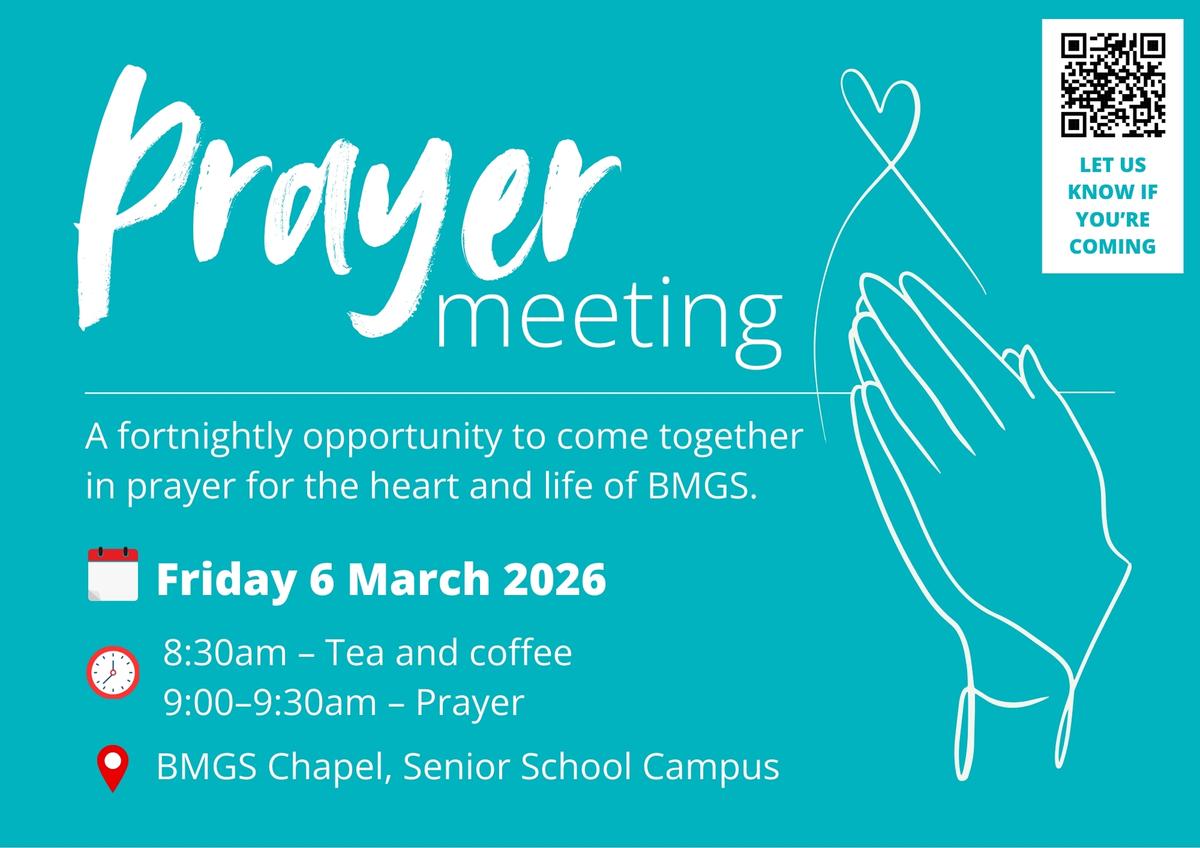
This is why we are beginning a new rhythm in our community. We are inviting people to gather and pray for BMGS and its people. This time will give us space to notice the pressures our community is carrying, celebrate the opportunities and good things growing among us, ask God to shape us into people who reflect His love and pray for our homes, schools, workplaces, and neighbourhoods.
Regardless of your faith position, background, or tradition, you are invited to join us. You do not need to have answers. You do not need to know what to pray. Just showing up is an act of hope. Feel free to join us in the Chapel on 6th March from 8:30-9:30.
As I said at the beginning of this piece, this is a hopeful piece of writing. The bad news stories we are told can steal our attention from all the beautiful things in our world. Take them back. Educator Art Costa describes a clear sign of intelligence as having the ability to respond with “wonderment and awe”. Notice, be awestruck, admire - these will give you a dopamine hit that will counter any journalistic report.
Warm regards
Steven Coote
Principal
This document has been reviewed for spelling and grammar. Please note that as such, it may identify some content as being generated by AI.