
Learning Specialist News
Be Kind
Be Responsible
Be an Active Learner

Learning Specialist News
Be Kind
Be Responsible
Be an Active Learner
Having spent valuable time and effort refining our literacy teaching practice, this year we have been aligning our Maths teaching with the instructional model developed and refined last year (see image below).
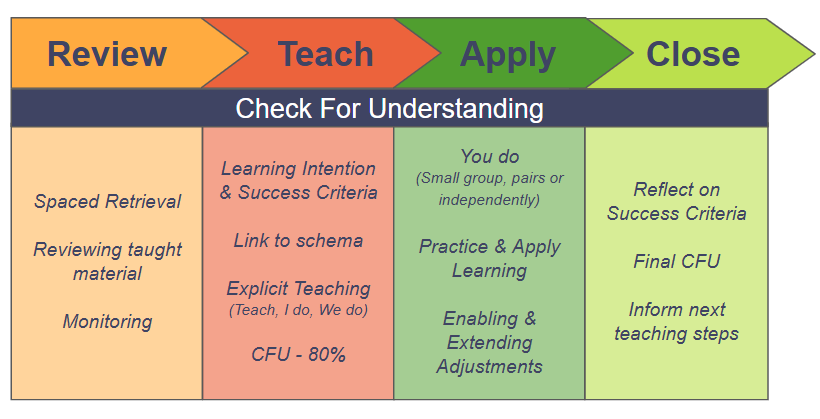
Direct Explicit Instruction (DEI) is a key component of our instructional model. DEI (often called “explicit teaching”) is a structured and highly effective way of teaching mathematics that makes learning clear, visible, and achievable for all students.
In a maths classroom using this approach, the teacher doesn’t simply set tasks and hope students figure things out. Instead, they carefully guide students through new concepts step by step.
A typical lesson might look like this:
This approach is particularly powerful in Mathematics, as learning builds on prior knowledge. When key concepts are missed, future learning can be more challenging. DEI helps prevent these gaps by ensuring concepts are taught clearly and misconceptions are addressed early. It also allows teachers to identify and respond to student needs within the classroom.
At SMPPS, we are continuing to strengthen our Mathematics teaching to achieve the best outcomes for every student. As part of this, we have been exploring resources such as Ochre and the Victorian Lesson Plans.
Across Australia, literacy and mathematics specialists, and organisations such as Melbourne Archdiocese Catholic Schools (MACS) have partnered with Ochre Education to develop high-quality, ready-to-use lessons in English and Mathematics. These lessons use DEI to support clear, structured and consistent teaching in every classroom.
We are also exploring the Department of Education’s ‘Victorian Lesson Plans’, which align closely with this evidence-based approach. These resources support all learners by providing opportunities for extension, targeted support, and meaningful application of knowledge, while still allowing teachers the flexibility to tailor lessons to their students.
Over the past 18 months, we have incorporated elements of these resources to support the introduction of Mathematics Curriculum 2.0 and build a consistent, school-wide approach to teaching and learning.
Our Annual Improvement Plan highlights the importance of building teacher capacity to embed our instructional model while strategically using planning resources and routines to foster deep cognitive engagement and intellectual challenge in Mathematics. Therefore, in 2026, our focus is on using these resources thoughtfully to meet our students' needs.
While these resources support consistency and reduce planning time, our teachers continue to use their professional judgement to ensure learning remains engaging, meaningful and effective.
This is an exciting journey for our school, and we look forward to continuing to strengthen our Mathematics teaching to support every child.
Ben Sanderson