Principal's Message

Tim Newton

A message from our Principal
Music at MPPS
Music is such an important part of school and community life in our community. I wanted to take this opportunity to highlight the importance of our music programs at Middle Park Primary School. Hopefully you are aware of the many and varied opportunities for students to engage with music. I thought it timely to list as many as I could think of just in case there was an opportunity that people may not be ware of.
Fundamentally, we have a Performing Arts program which all students attend each week as part. This week we appointed Aliki Watson-Jones as the teacher of that program to replace Linda who has recently left. We are very excited to welcome Aliki who has an extensive music background as a teacher and performer.
Hello Music and Junior Rockers run individual music lessons specialising in drums, violin, keyboard, piano, guitar and vocal to name a few.
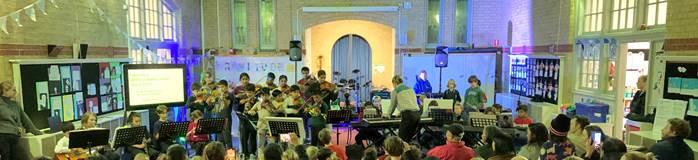
We also proudly boast Natalya Vagna, a world renown composer, who successfully runs individual piano lessons as MPPS. Natalya also runs our junior and senior orchestras on Tuesdays and Thursday mornings from 8am. All abilities welcomed.
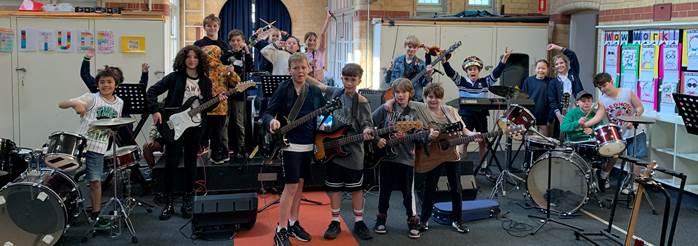
I personally run three rock/ pop groups. We have the well know Golden Chillies band as well as a junior rock jam group. Recently, we have established an ‘all girls’ group who are very quickly gathering momentum. Once again, all abilities welcomed.
Recently, during Wednesday lunchtimes, James Tutton has been running a ‘Beat Making’ electronic music club open to all year 3 and 4 students. We have had a full class each week so far and the students attending have been super excited to program and share their own mixes! James plans to run a ‘user pays’ program from the start of term 4.
We are also hopefully commencing an after school ‘Glee Club’ which will run on Wednesday afternoons. More information will follow once that’s locked in.
Our aim is to have every student learning an instrument and involved in a group. Playing or singing in a group also has enormous social and health benefits.
Why is learning music so important?
As a parent, we want the best for our children’s growth and learning, and one powerful way to support their development is through music. Learning music isn’t just about playing an instrument or singing; it actually helps brain development in amazing ways that can improve their skills in school, their social life, and even their emotions.
Research shows that when children learn music, their brains become stronger and more connected. According to scientists Herholz and Zatorre (2012), musical training helps the brain build new pathways, making it better at processing sounds, moving the body, and focusing attention. For primary-aged kids, this means that practicing music can help them become better learners overall.
One of the clearest benefits of music is how it supports language skills. Learning music helps children recognise different sounds, which is important when they’re learning to read and write. A study from the University of Toronto found that children who took music lessons did better in tasks that involved memory and reading than children who didn’t (Moreno et al., 2011). This happens because music and language both use similar parts of the brain, so training in one can improve the other.
Music also helps children develop important thinking skills like attention, memory, and problem-solving. These “executive functions” are what children use every day to follow instructions, solve puzzles, and stay organised. For example, a study by Bugos and colleagues (2007) showed that people who learned piano improved their working memory and ability to switch tasks — skills that start developing in childhood and help children succeed in school.
Beyond thinking skills, music is a wonderful way for children to express their feelings and connect with others. Playing music together with friends or family helps children learn teamwork and empathy — understanding how others feel. Research by Schellenberg (2004) found that children who took music lessons showed increases in IQ, partly because music helps build emotional and social skills.
Music learning also changes the physical structure of the brain. Schlaug and his team (2005) discovered that children who learn music have larger brain areas linked to hearing, movement, and spatial awareness. This means music helps kids improve coordination and attention to detail — skills that benefit many parts of life.
We are so committed to provide an extensive range of programs that encourage all students to be involved. As a parent, encouraging your child to explore music can give them a big advantage. It’s a fun and rewarding activity that supports their brain development, creativity, and confidence.
Please let me know if you would like your child to participate in any of our programs.
References:
- Bugos, J. A., Perlstein, W. M., McCrae, C. S., Brophy, T. S., & Bedenbaugh, P. H. (2007). Individualized piano instruction enhances executive functioning and working memory in older adults. Aging & Mental Health, 11(4), 464-471.
- Herholz, S. C., & Zatorre, R. J. (2012). Musical training as a framework for brain plasticity: behavior, function, and structure. Nature Reviews Neuroscience, 13(9), 605–618.
- Moreno, S., Marques, C., Santos, A., Santos, M., Castro, S. L., & Besson, M. (2011). Musical training influences linguistic abilities in 8-year-old children: More evidence for brain plasticity. Cerebral Cortex, 21(9), 2042-2050.
- Schellenberg, E. G. (2004). Music lessons enhance IQ. Psychological Science, 15(8), 511-514.
- Schlaug, G., Forgeard, M., Zhu, L., Norton, A., Norton, A., & Winner, E. (2005). Training-induced neuroplasticity in young children. Annals of the New York Academy of Sciences, 1060(1), 219-224.
All the best,