
Wellbeing
Fiona Dandie & Robert Pain
Wellbeing
Fiona Dandie & Robert Pain






We have newly introduced an Emotion Wheel as a resource across the school to support students in developing emotional literacy. We are excited to share how this simple tool is already helping children better understand themselves and others.
Emotional literacy is the ability to:
It goes beyond “happy,” “sad,” or “angry.” Emotional literacy gives children a broader emotional vocabulary, helping them make sense of what is happening inside them.
When children can accurately name a feeling, they are much more able to manage it.
Self-regulation is the ability to manage our emotions, behaviour and reactions, especially in challenging moments.
If a child can only identify feeling “angry,” their reaction may be quick and strong. If they can recognise they are actually feeling “left out,” “embarrassed,” “worried,” or “disappointed,” they have a clearer starting point for problem-solving.
Naming an emotion helps calm the brain. It creates a pause between the feeling and the reaction, and that pause is powerful.
The Emotion Wheel supports this by:
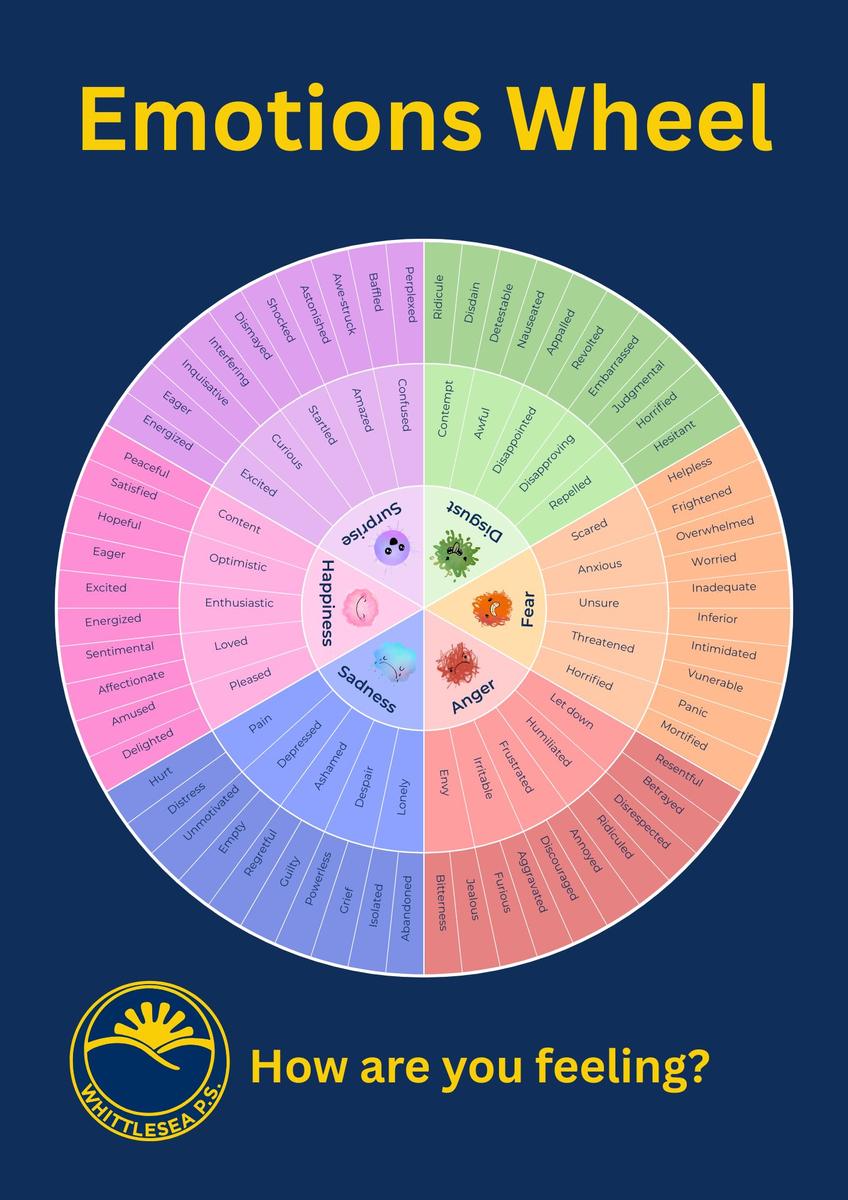
The Emotion Wheel doesn’t just support self-awareness — it strengthens empathy.
When children understand their own emotions, they become better at recognising emotions in others. They begin to think:
This shift moves children from judgment to curiosity, helping build kinder and more understanding friendships.
Across classrooms, students are learning to use the Emotion Wheel to:
We consistently reinforce that all feelings are okay, but not all behaviours are okay. Emotions give us information. Our response is what we learn to manage.
You might try:
When adults use emotional language openly, children learn that feelings are normal and manageable.
By introducing the Emotion Wheel as a shared school resource, we are building a consistent language around emotions. Emotional literacy strengthens children’s ability to:
Teaching emotional language is not separate from learning; it strengthens the foundation for it.
Feel free to download the Emotions Wheel poster if you think it would be helpful at home, as your child's classroom teacher, or the wellbeing team, for a copy.
Whittlesea Primary School's 'Calm Down' strategies:
Deep breathing exercises are a simple yet effective way to calm students when they are dysregulated in the classroom. Slow breathing in through the nose and out through the mouth can slow the heartbeat down and help the student calm down.
Distraction can sometimes help a student stay calm. A variety of books, calm colouring, word finds, and fidget toys can be useful. Having books in the calm-down space provides children with a distraction from their emotional state. Drawing and colouring are forms of art therapy and help children to calm down and express emotions. Each classroom's calm-down space has a supply of colouring books, calming colouring, plain paper, and sharpened pencils for students to use.
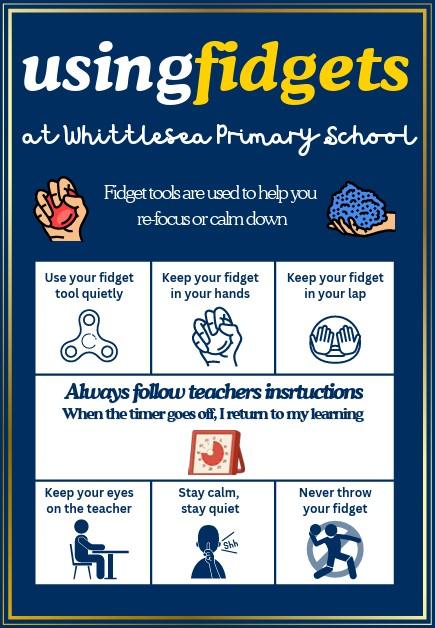
Sensory tactile objects, also known as ‘fidget toys’, are objects for students to hold and touch. They also help students to refocus and gain control over their emotions. A ‘calm down tool kit’ is available for students if required. Personal sensory boxes can also be developed to cater for individual needs.
Possible fidget toys could include:
• Stress Balls – Students can squeeze and poke the stress ball to release negative emotions.
• Calming Bottles – Fill a plastic bottle with water and items such as glitter and jelly beads. Students can stare at the glitter floating around. This settles their breathing and emotions.
• Bottle of Bubbles – This helps students control their breathing and calm down.
• Small Puzzles – Puzzles distract students away from negative emotions, calming them down.
• Stretchy Bands – Put a range of different-sized rubber bands in the kit for students to pull and stretch.
• Pipe Cleaners –Students can bend them into different positions.
• Noise-Cancelling Headphones – Some students become overwhelmed when there is too much noise. By blocking out the noise, the student can calm themselves down.
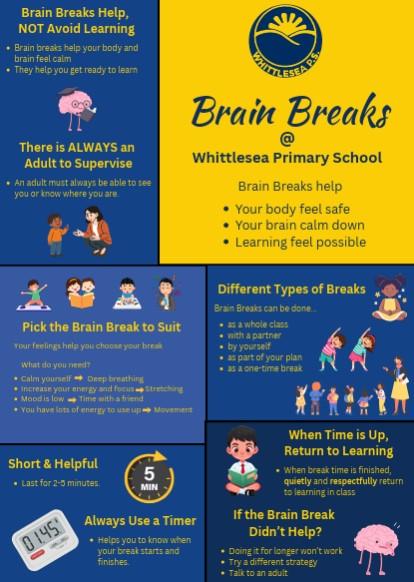
Brain Breaks:
During learning time, all teachers will use a variety of Brain Breaks that are simple physical and mental exercises. They have a positive effect on learning by:
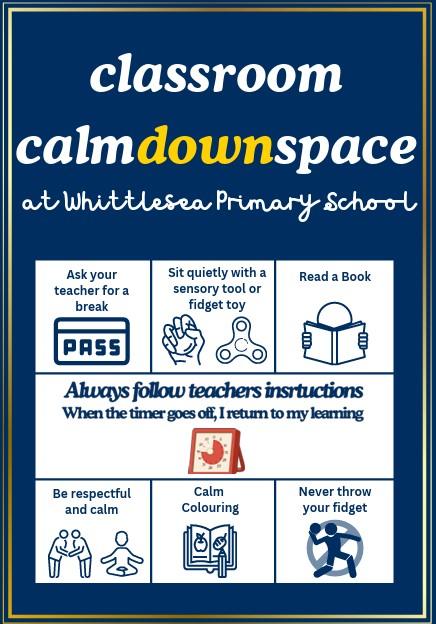
Calm Down Spaces:
When students are dysregulated, they may need a space to regulate their emotions and be ‘calm’. All learning areas at WPS have a designated classroom area where students can take time to regulate and then continue their learning.
When students feel great frustration, anger, sadness or anxiety, they become confused and may be unsure how to control their emotions. By providing them with a quiet place to calm themselves down, students can regain control over their emotions. This also provides opportunities for diffusing a negative emotion or situation
before it escalates.
Setting up a ‘calm down space’ in the classroom gives students the responsibility of self-regulating their emotions in a peaceful and safe place.