
Assistant Principals' Report
Belinda McGee, Kristin Skennar, Wes Pfitzner, Elisha Sadikay
Assistant Principals' Report
Belinda McGee, Kristin Skennar, Wes Pfitzner, Elisha Sadikay
Welcome to the first newsletter of 2026. We would like to open by saying how impressed we are with the way our students have begun the year, with high attendance, pride in their uniform, and a commitment to learning in each lesson. It seems clear that the high expectations that we have of our students are motivating them and supporting them to demonstrate the readiness to learn and engagement that we value so highly.
Our teachers have also been incredibly productive, and are working collaboratively to enhance classroom culture by establishing routines, teaching behaviours and cultivating care, trust and belonging. As part of the Department of Education’s three year roll out of the new Victorian Teaching and Learning Model, teachers are also now applying their learnings around working memory and cognitive load from last year to the task of reviewing the curriculum to ensure that our Learning Objectives are sequenced to support the transmission of knowledge into our student’s long-term memory. As part of this work, we have also been reviewing our lesson plans with a goal to establish greater consistency in the way these are presented to students across the College.
A piece of this work has included a team of leaders investigating how learning at home can best support the retention of knowledge in long-term memory, and developing guidance documentation for students and families about a practice called Daily Review. It’s clear from the research that effective Daily Review of the day’s learning, which is simple, regular and handwritten, is a key factor in maximising student growth, and more effective than other types of homework in making sure that learning sticks. We have included the guidance in this newsletter and look forward to partnering with families across the College to support your young person engaging in Daily Review at home.
If you would like to read more about the new Teaching and Learning Model, please find the Department of Education’s parent information page and resources: Victorian Teaching & Learning Model
We would like to encourage students and families to provide us feedback about anything they have noticed around this focus that their child may have discussed, please feel free to email doncaster.sc@education.vic.gov.au with your feedback.
As part of our commitment to partnering with families, there have been information evenings presented by each mini school at the beginning of the year. The first of several camps has occurred, which has developed the personal and social capabilities of our learners and fostered school connectedness. Thank you to those families who have engaged in these events. We really value your ongoing commitment to the college and the outcomes for your child.
Road Safety
Assemblies across the College have prioritised discussing and teaching students how to enter and exit the school safely, including how to cross a road and use a bus stop.
We have identified several students who struggle to enter and exit the school safely, which has been observed by supervising teachers and members of the public who have reached out to the school.
Some dangerous behaviours that have been observed include:
We ask that parents/carers prioritise discussions with their students around road safety, and that they model correct behaviour to minimise the possibility of harm.
If you would like more information or support with this, you can go here: Road Safety Victoria
Attendance
A strong start to the year also means establishing consistent routines for attendance. At DSC, we know that high attendance is one of the strongest predictors of academic achievement, wellbeing, and readiness for future pathways.
In 2025, our student data showed a strong correlation between attendance and academic success. Students who maintained 90% attendance or higher were significantly more likely to achieve high ATARs and demonstrate more consistent learning growth. As we enter 2026, we strongly encourage families to prioritise daily attendance when making decisions that may affect time away from school.
Family Holidays During Term Time
The College strongly discourages family holidays taken during the school term. The attendance guidelines provided in DSC mini school attendance guides highlights the term‑time absences for family holidays are not approved, as they interrupt the sequence of teaching and guided practice and can impact:
Assessment Implications
Learning Expectations During Holidays
Students are expected to keep up with Compass lesson plans during any absence. Teachers are not required to provide additional materials or catch‑up sessions once a student returns.
Compass Access When Travelling Overseas
Before leaving Australia, families must ensure:
Holiday Notification Form
Families must complete a holiday absence form at least eight weeks before travelling. The form requires families to acknowledge impacts on attendance, assessment, and learning progression. Please contact relevant Mini school for this form.
Reporting an Absence
To report a student absence please phone 9848 4677 and select 1 for Senior School, 2 for Middle School or 3 for Junior school.
Students are expected to be at school at 8.40am. Period 1 commences at 9:00am. If you are aware your child will be late to school, parental approval should be submitted in the Compass portal, or by notifying the relevant Mini-School.
Students arriving late must sign in at their relevant Mini-school and take their late pass straight to their timetabled class where the classroom teacher will update the roll and mark them as late. Where a parent approval hasn’t been submitted on Compass prior, the absence will be shown as an unexplained absence until an approval is submitted. Should a written note from a parent be provided with the student when they arrive, it should be brought to the General Office at recess or lunchtime, and it will be entered in Compass.
Throughout the school day, again, to maximise learning time and promote the importance of being punctual, students arriving late to any class will be recorded as late. Parents are asked to have a conversation with their child about the importance of being on time to class and then acknowledge/clear the unexplained late arrivals in Compass by using the ‘Parent Choice’ reason, assuming no other reason is suitable.
Early Departure from School
If a student has an appointment and needs to leave early, parents should enter an approval in Compass and select the appropriate reason from the list of options stipulated by DET. The approval appears on the class roll to alert the classroom teacher, and the student will be excused from class when they ask to leave at the designated time. Students should then attend the appropriate mini school to sign out.
If a parent provides a written note on the day or a note in their student's diary, this should be taken to the mini school before school or at recess, and it will be entered into Compass. Students will not be permitted to leave class without an approval entered in Compass.
If you need to collect your child unexpectedly, please contact the General Office.
Understanding Absence Codes at DSC
As part of our attendance responsibilities, the College is required to record all student absences using specific codes provided by the Victorian Department of Education. These codes help us ensure that absences are recorded accurately and that students receive the appropriate support when they are away from school.
To assist families, we have outlined the main categories below, along with guidance on when each should be used.
Medical, Health and Wellbeing
Use these codes when a student is away due to:
These absences are generally approved once a parent explanation or medical certificate is provided.
Family and Cultural Reasons — Including “Sorry Business”
What “Sorry Business” Means
“Sorry Business” is a specific term used within Aboriginal and Torres Strait Islander communities. It refers to cultural protocols around grieving, funerals, and responsibilities following a death.
It is only appropriate to use this code when:
When Not to Use “Sorry Business”
We kindly ask families to avoid selecting “Sorry Business” unless it genuinely applies. It should not be used for:
If an absence is for another family‑related reason, please select an alternative code such as:
Using the correct code helps ensure we honour cultural practices respectfully while keeping accurate attendance records for all students.
Education, Curriculum and Study
These codes apply to school‑related activities such as:
These are not counted as absences, as the student is still participating in school‑approved learning.
Student Circumstances
Used when absences relate to:
These codes help ensure duty‑of‑care and wellbeing procedures are followed.
Late Arrivals and Early Departures
These codes show when a student:
Recording this accurately helps us monitor punctuality and ensure all students are safely accounted for during the school day.
Why Accurate Codes Matter
Correct coding allows the College to:
Not Sure Which Code to Select?
Please contact your child’s Mini School or the General Office. Our staff are always happy to help ensure absences are recorded correctly.
Child Safety and Wellbeing at Doncaster Secondary College
Doncaster Secondary College is committed to providing an environment where students are safe and feel safe.
Our child safety framework explains how we support and maintain child safety and wellbeing at Doncaster Secondary College. It includes our:
You can access these documents on our school website.
Our students and families are important partners in providing a child safe environment. These regular newsletter reminders are one of the ways we ensure our school community is aware of:
If you have any concerns about child safety at any time, please contact a member of the principal team on (03) 9848 4677. Any child safety complaints or concerns are treated seriously. For more information about our school’s complaints process, see our Complaints Policy.
We also welcome your ideas on ways we can improve our approach to child safety and wellbeing. If you have any suggestions or comments please contact Wesley Pfitzner, Assistant Principal for Wellbeing and Inclusion on (03) 9848 4677 or via Compass email.
Emergency Management Practice
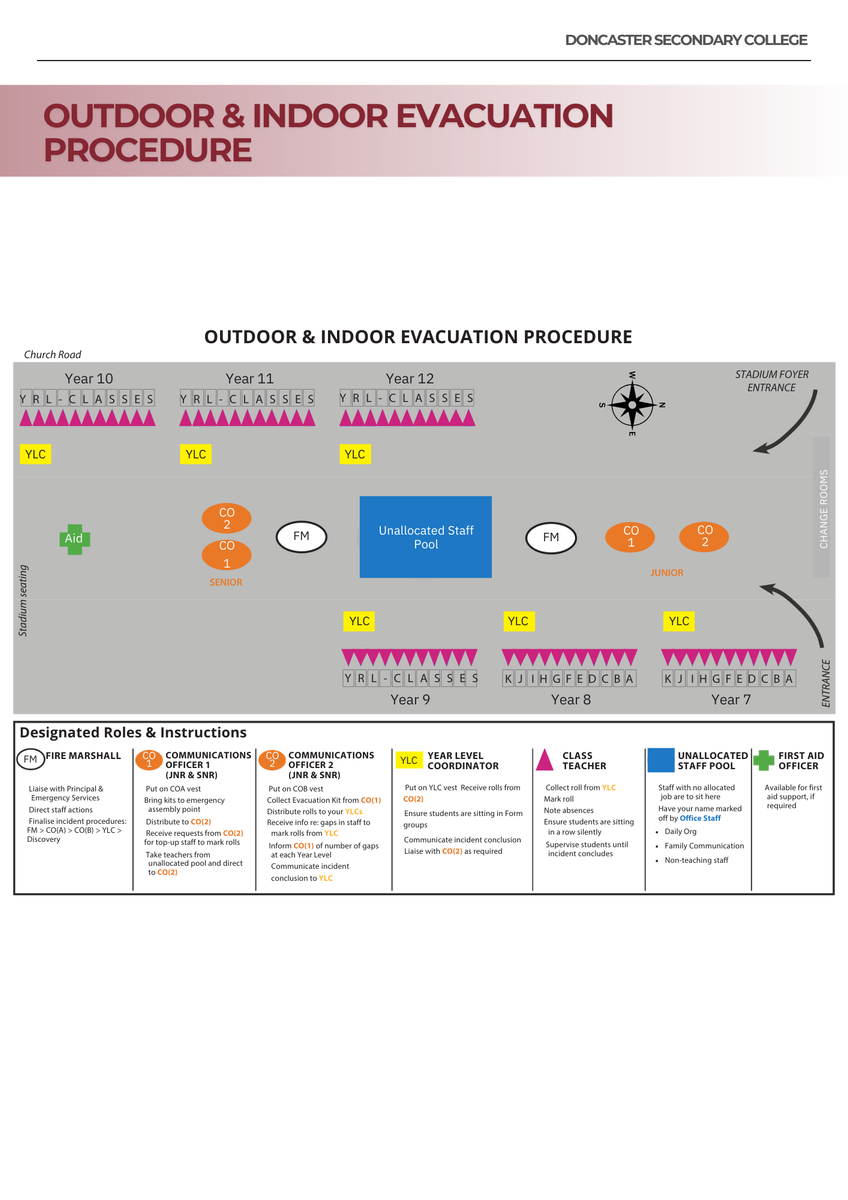
Each year we review our emergency evacuation and lock down practices to ensure that staff and students understand their role in the process, particularly in the unfortunate event that requires us to activate these processes.
During term one we will run a whole school evacuation to the oval, each term we select one of our emergency processes to test. Part of this process may also involve communicating directly with families via email or SMS. We would encourage you to ensure your contact and emergency contact information for your child has been updated, you can do this be requesting the Family contact information form from the General Office.
Annual Privacy Reminder for our School Community
Our school collects and uses student and parent personal information for standard school functions or where permitted by law, as stated in the Schools’ Privacy Policy and the Schools’ Privacy Collection Notice.
Our Photographing, Filming and Recording Students Policy, describes how we collect and use photographs, video and recordings of students. The policy al so explains when parent consent is required and how it can be provided and withdrawn.
We ask parents to also review the guidance we provide on how we use Microsoft 365 safely at the school and what parents can do to further protect their child’s information. If after reviewing the guidance, you have any questions or concerns regarding your child using Microsoft 365 please contact the school.
For more information about privacy, refer to: Schools’ privacy policy: information for parents. This information is also available in ten community languages:
Warm regards,
Belinda McGee, Elisha Sadikay, Wes Pfitzner and Kristin Skennar
College Assistant Principals