Learning Area News
Foundation News
Literacy
In Literacy, we have been reviewing the letters ‘m’, ‘s’, ‘t’, ‘a’, ‘p’, ‘i’, ‘f’, ‘r’, ‘o’, ‘c’, ‘d’, ‘h’, ‘g’, ‘e’, ‘n’, ‘l’, ‘k’, and ‘u’, along with the sounds they make. We have also been practising the tricky words were and has, using them in our writing and incorporating them into sentences.
The students enjoyed creating a book about themselves, which provided an opportunity to practise writing complete sentences. They focused on using capital letters at the beginning of sentences, leaving spaces between words, and ending sentences with full stops.
Numeracy
In Numeracy, we have been learning about shapes. We have been identifying shapes in our environment and naming them. We have been using straight lines and curved lines to draw circles, triangles, rectangles and squares. The students have also been practising counting forwards and backwards for 0-20 and 20-0.
Religion
In Religion, our topic is, ‘‘Finding God in all things’. Students have been learning about how God’s love can be experienced through creation and other human beings.
Inquiry
In Inquiry, we have been learning about the planets in our solar system. The children have been investigating the Sun, Mercury, Venus, Mars, and Jupiter, exploring some of the unique features of each. They enjoyed using their knowledge to create these planets as part of their own solar system craft projects.
At home you could reinforce learning by:
- Read a story with someone at home.
- Listening to your child read their reader each night.
- Practise writing your name with a capital letter at the start, followed by lower case letters (we may need an adult to assist/model this).
- Practise writing the letters ‘m', 's', 't', 'a', 'p', 'i', 'f', 'r', ‘o’, ‘c’, ‘d’, ‘h’, ‘g’, ‘e’, ‘n’, ‘l’, ‘k’ and ‘u', using lower case letters.
- Look around your home and identify shapes in your environment. Draw and colour the shapes you find in your environment and discuss what you have found with someone at home.
- Practise counting forwards and backwards from 0-20 and 20-0
Year 1 News
Literacy
In Literacy, students have been learning about the bossy ‘e' and how it makes the vowel sound long. We have been reading words with the bossy ‘e’ and creating lists of the different split digraphs. Our tricky words are before, after, these, work, baby and children.
Numeracy
In Numeracy, students have been learning about addition. We have been using tens frames, counters and number bonds to add together 1- and 2-digit numbers.
Religion
In Religion our topic is ‘Grief and Loss’. We have explored change using The Very Hungry Caterpillar and through exploring the different seasons.
Inquiry
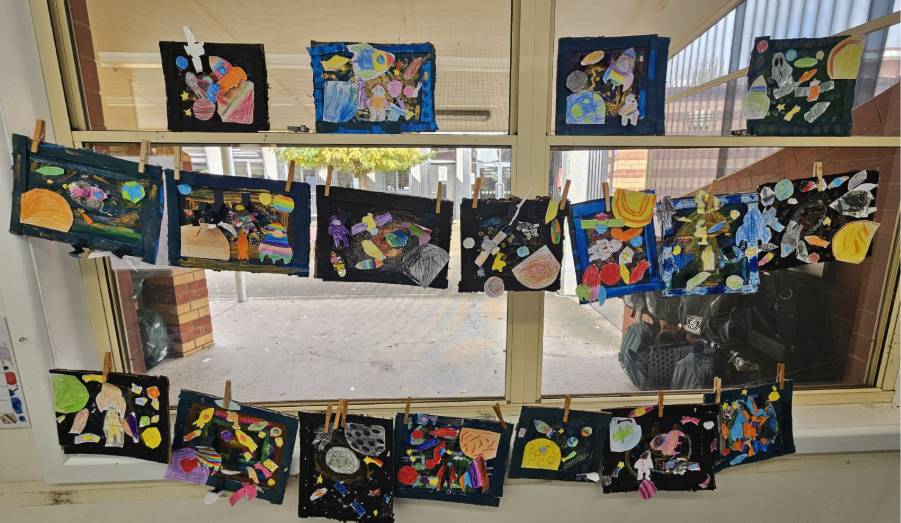
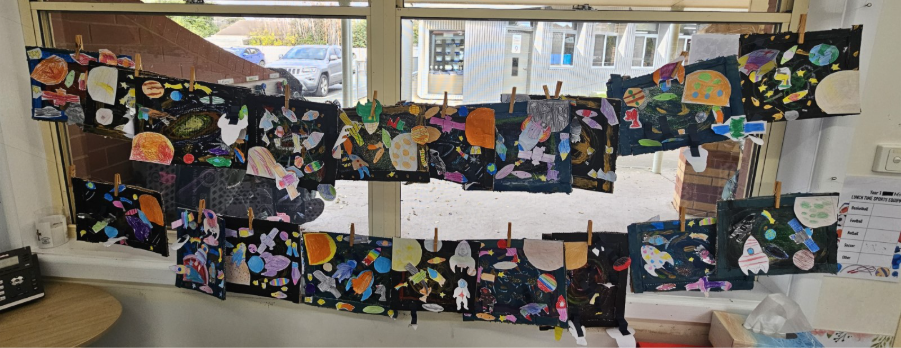
In Inquiry, students have been learning about the space. We have created amazing artworks of the solar system that included planets and stars.
At home you could reinforce learning by:
Literacy
- Find words in your take home reader with a bossy ‘e'.
- Practice putting the tricky words before, after, these, work, baby and children into sentences.
- Listen to your child read their reader each night.
Numeracy
- Use household items such as fruit or toys to add together 2 numbers.
- Use blocks to make a tower, adding on and counting the height.
Year 2 News
Literacy
In Literacy, during spelling, we have been learning r-controlled vowels – ‘ir’ (bird), ‘ur’(burn), ‘er’ (fern). They have also been exploring the digraphs ‘ow’ (cow), ‘ou’ (cloud) and ‘ch’(school).
Grammar
During grammar, the students have continued to learn about adjectives to describe a noun and to describe how someone is feeling. Students explored how adjectives can be written before or after the noun in a sentence.
Comprehension
During comprehension, the students have been using the ‘asking questions’ strategy when reading. Students were asked to think about questions before, during and after reading a text.
Mathematics
In Mathematics, the students have been measuring objects using informal units such as unifix blocks, dominoes and dice. The students explored how to choose appropriate informal units to measure different objects. They estimated amounts of each informal unit needed to measure an object before measuring and finding out the actual number of units. Students have been also learning about 'doubles’ and 'near doubles’ number facts.
Religion
In Religion our topic is ‘Grief and Loss’. We have used ‘The Very Hungry Caterpillar ‘and ‘The mustard seed’ stories to explore change and the students have reflected on change in their lives.
Inquiry
In Inquiry, students have been learning about the space. We have explored the planets and stars in the solar system. Students have learnt about the rocky and gas planets, and different types of star constellations in our sky.
At home you could reinforce learning by:
Literacy
- Find sentences in story books using adjectives to describe a noun or feeling.
- Listen to your child read their reader each night. Students could practice using the ‘asking questions’ strategy before reading by looking at the title and pictures to ask questions about the story. The students pause throughout the book to ask questions about what might happen next.
- Students are to practise reading and spelling the following ‘tricky’ words (lose, father, sister, build, house, about).
Numeracy
- Students practise ‘doubles’ number facts up to 20 to develop their automatic recall. For example: 3+3 = 6 OR 9+9 = 18.
- Students practise ‘near doubles’ number facts up to 20 to develop their automatic recall. For example: 3+ 4 = 7 OR 8+9=17.
Year 3 News
Welcome back to Term 2! We hope you all had a wonderful break. We are looking forward to another busy, productive, and exciting term of learning.
Literacy
In Literacy, students have been learning how to write a factual recount using strong topic sentences, supporting details, introductions and body paragraphs. We have also explored how to use because, but and so, past tense verbs, time connectives, adjectives, and stronger verbs to make writing clearer and more interesting.
SpellEx
During our SpellEx program, students have been learning tricky words such as please, really, people and believe, as well as long vowel sounds like /ī/ and /ō/. They have also been practising phonemes, graphemes, homophones, prefixes, suffixes, sentence dictation, and spelling rules, including when to double letters before adding endings. We are immensely proud of the learning we are seeing, and the connections students are making in their writing.
Mathematics
In Maths, students have been building their understanding of fractions by exploring halves, thirds, quarters, fifths, and tenths. They have been learning to recognise fractions in shapes and collections, write fractions correctly, and show them in different ways using pictures, counters, diagrams, and fraction strips. Students have also been practising how fractions can be combined to make one whole, helping them grow in confidence when working with parts and wholes.
Religious Education
Our new RE unit for the first five weeks of term is titled ‘Circle of Life’. Students are learning about love, connection, change, and loss. They will explore how we stay connected to the people we love and to God, as well as how Jesus experienced sadness and loss. Together, we are discussing how people can have different feelings and responses during times of change.
Science
In Science, our focus has shifted to Living and Non-Living Things. Students have been learning to describe the features that all living things share, including that living things are made up of very small components called cells.
Humanities
In Humanities, students have begun a journey around Australia, using maps to locate each state and territory. They have explored natural and human features, including landscapes, climates and environments.
Homework activities to reinforce learning:
- Fraction hunt: Find examples of halves or quarters around the house, such as fruit, sandwiches or folded paper. Talk about what fraction you can see.
- Draw and shade: Draw simple shapes and divide them into equal parts. Shade one half, one quarter or one third.
- Make a collection: Use small objects like buttons, pasta, or LEGO to show fractions such as 1/2, 1/4 or 1/5.
- Reading fluency: Please encourage your child to read their take-home book regularly using a clear voice, pointing to tricky words, rereading for fluency, and talking about what happened in the text.
- Conjunctions: Write three sentences using because, but and so.
- Topic sentences: Create a topic sentence about a favourite animal and add two supporting details.
- Recount writing: Write a short factual recount about the weekend using First, Next and Finally.
Year 4 News
Our Year 4 students have returned refreshed after the recent four-day weekend for the King’s Birthday. During this time, staff participated in wellbeing-focused professional learning, exploring strategies to support positive wellbeing and learning outcomes for all students. We hope families enjoyed the extra time together and that students are ready for another productive fortnight of learning.
It has been wonderful to see students continuing to demonstrate positive learning behaviours, resilience, and enthusiasm in the classroom. They have been engaging thoughtfully with new learning experiences and are showing increasing confidence when sharing their ideas and working collaboratively with their peers.
Below is an overview of what we have been learning across key areas, along with some suggested activities to support learning at home:
English
In English, students have begun exploring our new novel study, The Arrival by Shaun Tan. This unique text contains no written words, encouraging students to closely analyse illustrations and use inference skills to determine what may be happening in the story. Students have enjoyed discussing their ideas and supporting their thinking with evidence from the images.
We are continuing to develop our spelling knowledge through the SpellEx program and have recently completed DIBELS reading assessments to monitor student growth and identify future learning goals. Students have also been working on sentence expansion activities, focusing on adding detail and complexity to their writing. Building on these skills, students have begun planning and creating their own narrative stories in comic-book format.
Numeracy
In Numeracy, students are exploring data representation and learning different ways to collect, organise, and interpret information. They are creating and analysing graphs and discussing how data can be used to answer questions and make conclusions.
Students have also been extending their understanding of addition and subtraction by solving increasingly complex problems that require multiple steps, efficient strategies, and strong number knowledge.
Religious Education
In Religious Education, students are continuing their learning about Mission and the Church. They are exploring how people within the Church community work together to support others and live out the values of faith, service, and compassion in everyday life.
Science
In Science, students are further developing their understanding of distance forces. Through investigations and discussions, they are examining how forces such as gravity and magnetism affect objects and influence movement without direct contact.
Humanities
In Humanities, students are continuing their inquiry into Managing Earth’s Resources. They are exploring sustainable practices, considering ways to reduce waste, and investigating how individuals and communities can make responsible choices to help protect the environment.
At Home You Could Reinforce Learning By:
Independent/Guided Reading:
It is the expectation in Year 4 that your child practises reading independently or to a family member for at least 10–20 minutes each night. Regular reading supports fluency, comprehension, vocabulary development, and confidence.
Students are encouraged to borrow books from the classroom or school library and are also welcome in the library from 8:30am each morning to borrow and return books, read independently, or read with a staff member.
Fluency Practice:
Continue practising number facts in addition, subtraction, multiplication, and division. Strong recall of basic facts supports students when solving more complex mathematical problems.
Narrative Writing:
Encourage your child to create short comic strips, narratives, or stories at home. Discussing characters, settings, and story events can help strengthen their creative writing skills.
Spelling Skills:
Support spelling development through regular practice of words from the SpellEx program, along with reviewing common spelling patterns and high-frequency words.
Maths:
Encourage your child to collect simple data at home and represent it using graphs or charts. Discussing information presented in tables, graphs, and surveys can help reinforce classroom learning.
Year 5 News
The Year Five children are working on producing a modern-day parable as a part of our Religious Education unit on Reconciliation. In this unit, students will explore the idea that when we are truly Reconciled, we are living in Right Relationship with one another, our world and our God.
What are the chances of Carlton winning the AFL grand final? We have been exploring probability in mathematics, conducting a variety of experiments to test our theory of events occurring. Are they likely or unlikely to happen? What's the likelihood of Carlton winning the grand final – not sure if a magician can help here! What's your prediction for the AFL grand final?
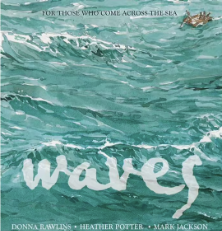
Waves is a collection of stories, an anthology, of various characters that have come across the seas to make Australia home. Whilst the stories are ficticious, they are based on real life people. What's your family's story? How did they end up in Australia? Spend some time as family sharing your family's voyage to Australia. If you are a First Nations family, what is your family story?
Need something to do at home?
Turn off the TV, put all devices away and spend time with your child. You research your family tree. What is a family tree? Do you have one? Could you make your own.
Spend time reading with your child each school night for at least 20 minutes – read with them, listen to them, read to them. Then practice the timetables. 30 minutes of quality time together is the best learning you will ever experience.
Just a Reminder:
We have many children bringing in squishy toys, fidgets or other items that are distracting our learning.
We understand that some children require these to help them settle and feel at ease, however when they become trading items, are lost or broken, then they defeat their purpose.
If you child requires one of these please let us know and we will try and make sure they are used as they intended for.
Year 6 News