
Diverse Learning
Ms Janelle Schembri | Diverse Learning Coordinator
Diverse Learning
Ms Janelle Schembri | Diverse Learning Coordinator

Looking at people when they are talking to you is an important social skill. Most children learn early on that this shows the other person that they are interested in them and what they are saying. These children naturally make good eye contact with others ( unless they are in trouble or feeling scared, guilty or intimidated). Some children do not learn to make eye contact naturally. This may make them seem unfriendly, vague or disinterested.
Not making eye contact with the person your child is talking to may make the person that they are talking to feel uncomfortable or ignored. It may also be harder for your child to pick up information from facial expression or watching lips moves if they are not making eye contact.
Ways to help your child at home...
Explain to your child that it is important to look at people when they are speaking to them and when they are speaking to you. The rule of thumb is that you should always look at the other person when they are speaking but you can look away occasionally when you are doing the talking. Let your child know that looking at people when you are having a conversation makes you look friendlier and helps to understand more of what people are saying. People also expect you to look at them when you are talking.
Give your child lots of praise if they look at you when you ( or they) are talking. When you praise your child, be specific, that is, tell them exactly what they have done well, e.g. you could say ”That's great! You were looking at my face the whole time that I was talking!”
Remind your child to look at you before you start speaking. Do not begin speaking until your child is looking at you.
Use a simple reward system. This will help your child over a period of time. It will also make your child motivated to remember to look at the person talking because they will be earning rewards for themselves. ( Stay tuned for how to create a reward system in our next newsletter).
DON’T FORGET!
Your child has already developed a habit of not making eye contact and habits can take a long time to break. Current research indicates it can take up to 10 weeks to break a habit so have patience with your child and be encouraging. Let your child know that you understand that it is sometimes difficult for them to look at people when they are talking.
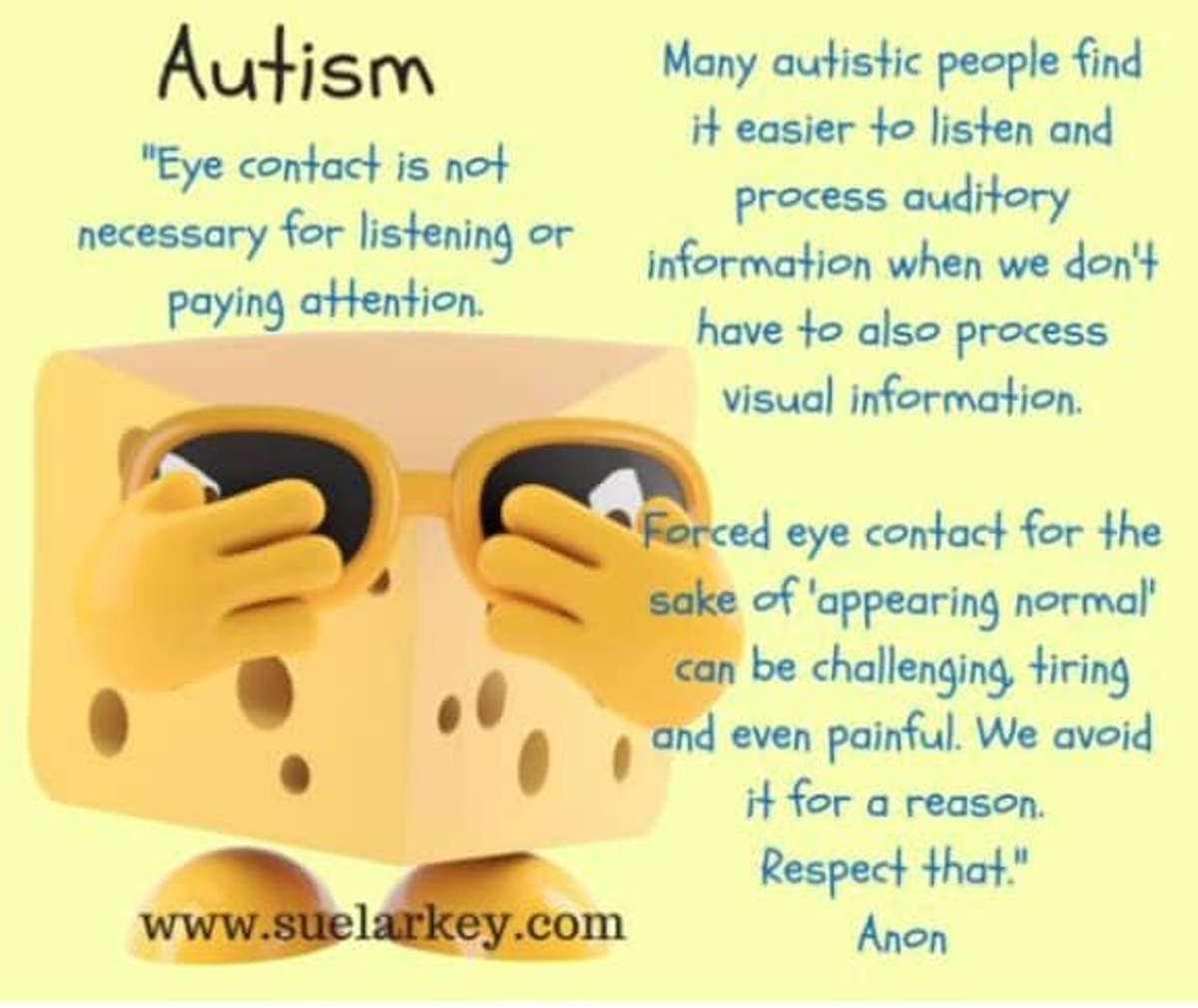
Please note: Some students on the Autism Spectrum find making eye contact very stressful. In many cases when children are not looking at people’s eyes /faces, people assume the child is not paying attention or listening. However, with these children we must be cautious not to assume that not looking means not listening, in fact, many children on the Autism Spectrum report listening best with their eyes closed or when they look away. Recent research indicates that teaching these students ‘eye gaze’ where they focus on another part of the face rather than the eyes to be more beneficial. More information can be found on Sue Larkey’s website.

Ms Janelle Schembri | Diverse Learning Coordinator