
Year 7 Enhancement Studies
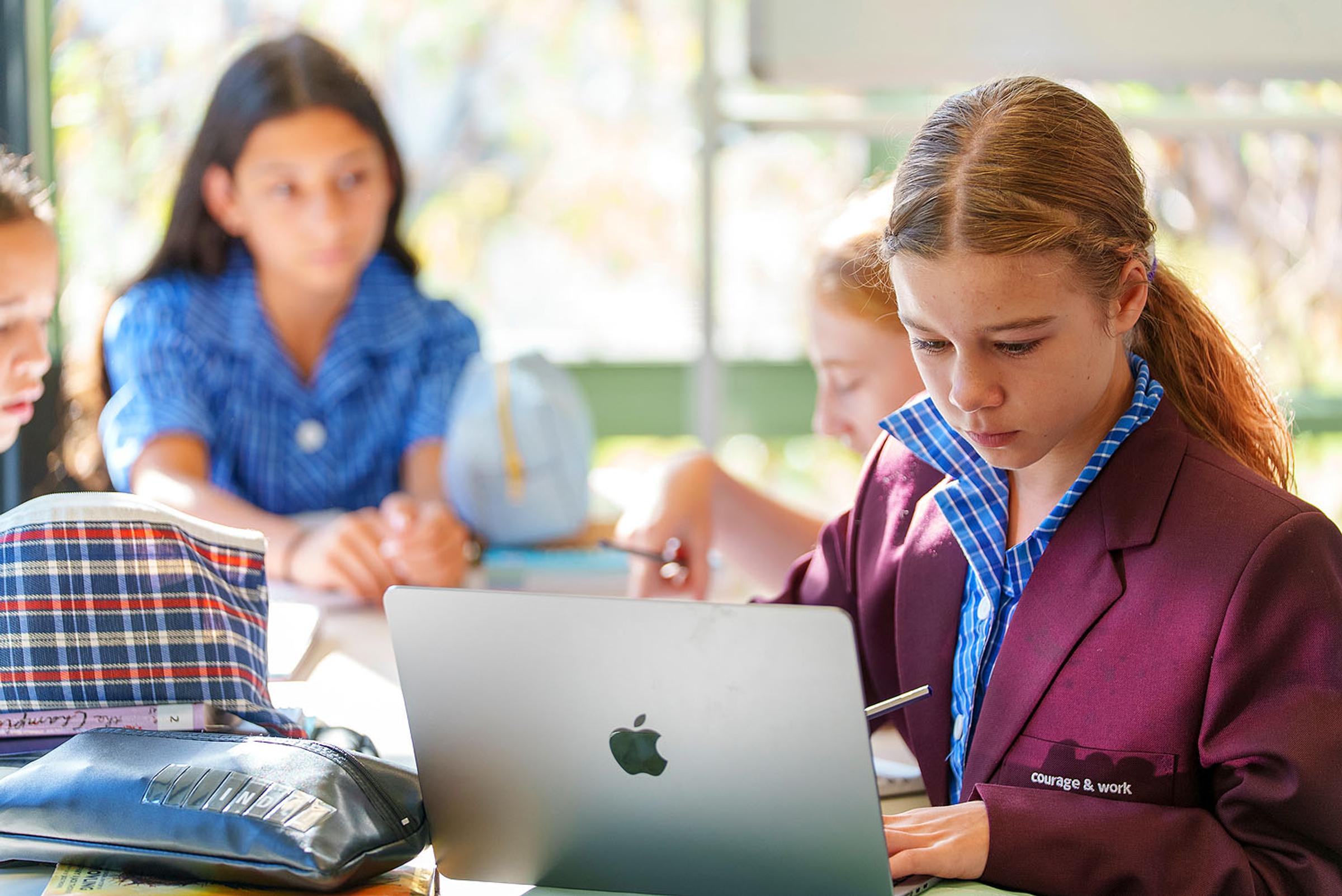
The program offers extension studies in English, Mathematics, Science and Humanities.
Enhancement ALL (Active Learning Links)
The ALL program combines the study of English and Humanities and is designed to help students understand themselves as learners, identify their preferred learning styles, problem solve and expand their social experiences.
English
Semester One
Students develop an analytical framework for essay writing when writing a historical essay. Students study the features of narrative writing such as characterisation, descriptive language, plot and setting when writing a myth.There is a significant focus upon literacy throughout the semester as students undertake writing activities, reading and targeted skill building tasks.
Semester Two
Students continue to develop essay writing skills in Semester Two when completing an analysis of the verse novel ‘Sister Heart’. Students explore adaptations and transformations by comparing and contrasting texts and producing a podcast. There is a significant focus on literacy and the ways that representations change through adaptation.
Assessment
Assessment in ALL links the subject areas of English and Humanities while ensuring explicit skills are developed in each area.
Historical essay: Students select an ancient civilisation, create their own hypothesis and using the TEEL essay structure.
Writing a myth: Students study the features of narrative writing and create an original myth, accompanied by a statement of intention that justifies their literary choices.
Women in History: Throughout the Women in History unit students explore biography writing and oral presentation skills.
Oral presentation: Students explore issues relating to liveability and write an oral presentation that proposes sustainable solutions.
Text Response Essay. Students analyse the novel ‘Sister Heart’ and write a text response essay to demonstrate their understanding of the text and their ability to write a sustained response to an essay topic.
Adaptations Podcast: Students create a podcast that compares how representations change through adaptation.
Humanities
Semester One
In Semester One, students will build their historical skills and knowledge in a critical study of an ancient civilisation of their choice and an inquiry-based study of a woman in history. In this study, students will develop their research skills as they investigate and interrogate the past.
Semester Two
In this semester, students will be developing their geographic and economic understandings. Students will explore the notion of liveability with regard to their local Australian context as well as major cities around the world. In doing this, students will engage with field work, investigative research and collaborative practices. Students will also explore the availability of water and water related issues. They will do this with discussion and investigation into the relationship First Nations people have with the environment.
Assessment
In Semester One, students will complete a research grid and write a historical essay based on their extensive research. Students will also produce a presentation on their chosen woman in history. In Semester Two, students will also investigate liveability, water systems and rivers, leading to a case study on the local area.
Throughout the year students will be engaging in formative research tasks, oral presentations, design tasks, source analysis, case studies and reports.
Enhancement Maths
Semester One
Students explore concepts of measurement including unit conversions, perimeter, area, surface area and volume. They consolidate their knowledge relating to whole numbers by studying concepts such as prime numbers, square, cube and index numbers, and multiples and factors. They also consider the function of integers (including negative numbers) and carry out a variety of mathematical operations using these numbers. Various statistical ideas are explored, including how to select and draw appropriate graphs with and without technology, calculate measures of centre and describe and interpret graphical displays. Solving problems with fractions and ratios completes the semester’s work., Throughout the semester, students are encouraged to develop key skills and apply their knowledge to solve a variety of problems.
Semester Two
Students continue to develop fluency in number skills, solving problems with decimals and percentages. They are introduced to concepts of financial maths such as profit, loss, discounts and mark-ups. Students learn about the process of substitution in the algebra unit, solving linear equations and using the four operations to simplify algebraic expressions. They explore more about coordinates, plotting points on the Cartesian plane and graphing linear relationships. They study geometry by classifying, measuring and calculating angles and exploring properties of two-dimensional shapes. They also cover the language of probability, how to calculate theoretical and experimental probabilities and learn to construct and interpret a variety of probability diagrams. Students undertake a digitech unit focusing on algebraic thinking and coding.
Assessment
Students will complete three CAT tasks per semester covering the Victorian Curriculum 2.0 areas of Number, Algebra, Measurement, Space, Statistics and Probability. In addition to CAT tasks, students will complete additional tasks as both formative and summative assessment. CAT structures will vary between topic tests, problem solving/modelling tasks, collaborative investigation tasks that all require the application of the mathematical content studied.
Enhancement Science
Semester One
Students are introduced to the science laboratory including the specialised equipment and safety rules. They use knowledge of mixtures to investigate a variety of separation techniques. Throughout the semester students engage in a variety of practical and investigative tasks to develop practical science skills.
Semester Two
Students explore both contact and non-contact forces including gravity, magnetism, friction and the electrostatic force. The forces involved in a falling parachute are investigated through the design and reporting of a practical investigation. Students identify differences within and between groups of organisms; and understand that classification helps organise this diversity. Interactions between organisms are studied by identifying different relationships between and within species and through the understanding of food webs.
Assessment
Students will complete two common assessment tasks (CAT) in each semester. In each semester students will undertake a scientific investigation as well as a variety of tasks which may include topic tests, writing a storybook explaining a scientific concept or a research project.