
Level 5: Connect
5A Michelle Stainforth, 5B Cazz Swanepoel, 5C Katie Hallowell

Level 5: Connect
5A Michelle Stainforth, 5B Cazz Swanepoel, 5C Katie Hallowell
Laptops - please ensure students come to school with fully charged laptops.
This week we commence our fortnightly Homework Grid.
Please refer to the Homework section in our Beginning of Year presentation for full details about the SEPS homework process.
The grid has been designed to promote student agency. Selections and completion of tasks should be made in consultation with your child. Students will be allocated a Homework exercise book on Friday.
Parents are asked to:
All written and drawn responses should be completed in the Homework book.
As tasks are completed, parents are asked to sign each box to acknowledge completion.
A reminder that this is home work. The teacher’s role is to support and monitor what is happening at home rather than directly supervise the completion of tasks.
If families decide that their child will not complete certain aspects of the Homework Grid in a particular cycle, please include a signed note in the Homework book.
With this communication in place, teachers can respectfully support each family’s approach.
Please ensure you have read the Homework policy linked above.
Why Daily Reading at Home Matters
At this stage of student learning, reading isn’t just about learning to read — it’s about "reading to learn". Every subject your child studies now depends on strong reading skills: Maths worded problems, Science explanations, Humanities research, even Health and Civics discussions.
Regular reading at home is one of the most powerful things families can do to support academic success and overall development.
Recent large-scale studies consistently show:
Students who read daily perform significantly better across all curriculum areas, not just English. The OECD PISA 2018 report found that students who read for enjoyment regularly scored substantially higher in reading, mathematics and science (OECD, 2019).
[https://www.oecd.org/pisa/publications/PISA2018_CN_AUS.pdf]
Just 20–30 minutes of reading per day can expose children to over 1.8 million words per year, dramatically increasing vocabulary, comprehension and writing ability (Anderson, Wilson & Fielding, 1988; cited widely in literacy research).
[https://www.readingrockets.org/article/exposure-words-and-vocabulary-development]
Home reading habits are one of the strongest predictors of long-term academic success, more influential than many other background factors (Sullivan & Brown, 2013).
[https://journals.sagepub.com/doi/10.1177/0003122412455684]
Regular reading also improves:
In short: reading builds brains.

At school:
At home:
This is a partnership. We work hard at school to build skill and provide structure — but home reading time is home time, and families play the leading role in maintaining the routine.
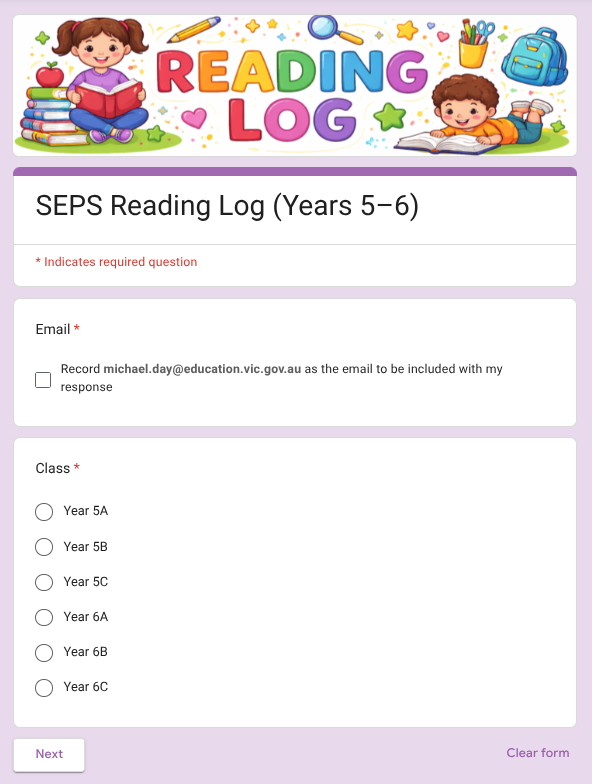
Simple actions make a big difference:
Structure creates habit. Habit builds skill. Skill builds confidence.
Working Together
Our goal is simple: strong, independent readers entering secondary school ready for complex texts and sustained thinking.
With consistent home reading — 20 minutes nightly — students gain:
We look forward to working in partnership with you in building this routine. When school structure and home consistency align, the results are powerful.
If you would like to explore the research further, the links above provide accessible summaries and reports.
Thank you for taking the lead in supporting your child’s reading journey.
As we prepare for NAPLAN, students have been strengthening their writing skills across both narrative and persuasive texts. Our focus has been on planning, drafting and editing within a set time frame, helping students build confidence, independence and effective time management under assessment conditions.
Narrative Writing
Students are learning to:
There has been a strong emphasis on creative brainstorming, selecting the most powerful idea and organising writing clearly before drafting. Students are working hard to use vivid vocabulary and thoughtful structure to engage their reader.
Persuasive Writing
Students are also learning to:
We have been focusing on building strong arguments, supporting ideas with convincing evidence and structuring writing logically to clearly communicate a point of view.
It has been wonderful to see students growing in confidence, refining their ideas and taking pride in their writing as they prepare for NAPLAN
In addition to our NAPLAN preparation, students have been focusing on applying their understanding of decimal numbers in a variety of real-life contexts, including measurement, money and data analysis. Lessons are designed to develop both accuracy and reasoning, as well as confidence in using decimals under time and problem-solving conditions.
Measuring and Comparing Length
Students are learning to:
Rounding and Estimating Money
Students are learning to:
Organising and Comparing Temperature Data
Students are learning to:
It has been wonderful to see students applying their decimal knowledge across multiple contexts, making connections between measurement, money and data, and building confidence in problem-solving and reasoning skills.
In Inquiry, we continue our journey exploring how exercise and sleep impact our wellbeing. Students are learning to make connections between daily habits and their physical and mental health.
The Role of Sleep
Students are learning to:
Leisure and Mental Health
Students are also learning to:
Through these lessons, students are reflecting on their own habits and considering ways to build routines that support wellbeing, helping them make healthy choices for both body and mind.
Warm regards,
The Level 5 Team - Michelle, Cazz and Katie
Important Dates:
Mar 3rd - District Swimming
Mar 9th - Labour Day
Mar 10th - 20th - NAPLAN Testing
Mar 26th - VSSS Schools Spec Rehearsal at Oakleigh South PS
Mar 27th- Community Arts Festival
Apr 2nd - Last day of Term 1