Mental Health and Wellbeing

Hello GPS Community,
This is a new newsletter segment I’m calling HERRRby’s Wellbeing Window – a ‘window’ into wellbeing and practices at our school.
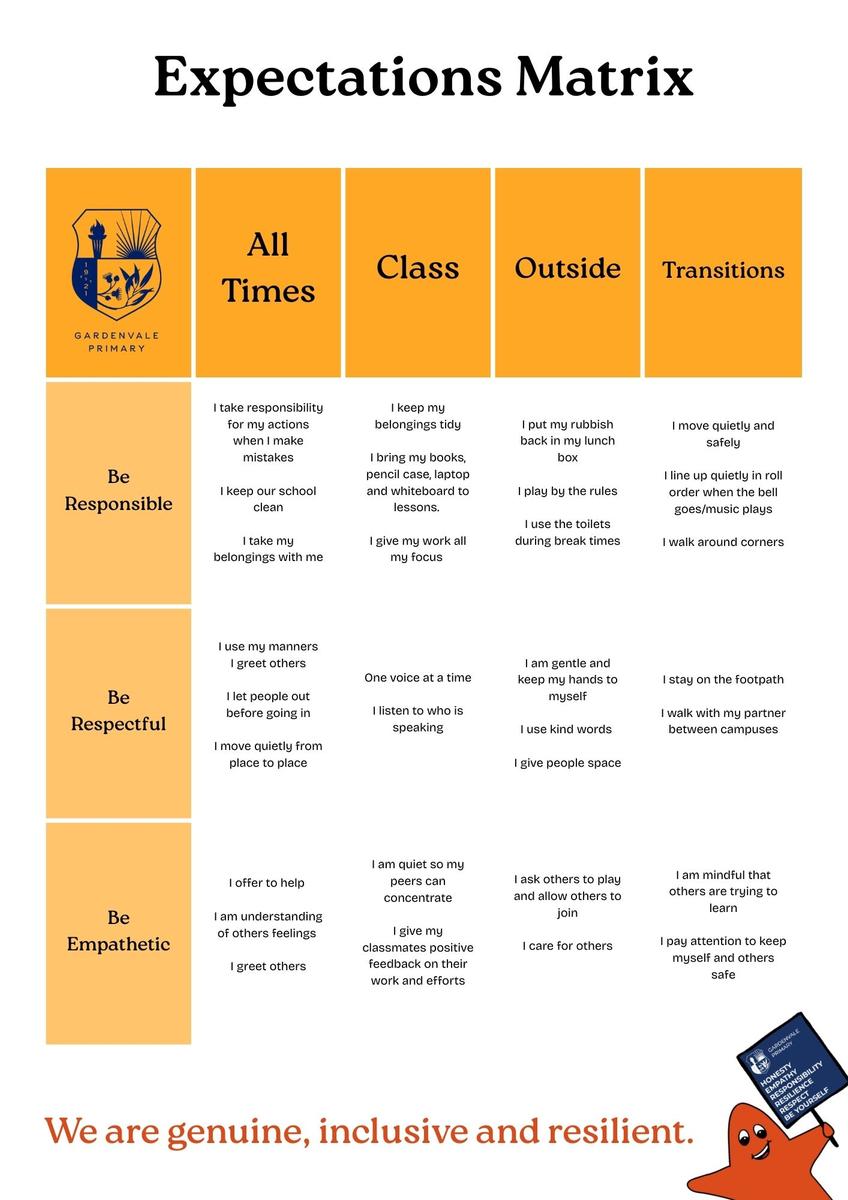
To kick things off, I’m going to tell you a bit more about the Expectation Matrix.
Many of you would have seen at the Parent and Carer Information Evenings that we are implementing a new system called the Expectation Matrix to support classroom behaviour, engagement and wellbeing.
This matrix comes from the Positive Classroom Management Strategies, which itself comes from the School Wide Positive Behaviour Support (SWPBS) – a globally recognised, evidence-based framework that helps schools create safe, positive, and inclusive environments where students and staff can thrive.
The SWPBS supports the Victorian Teaching and Learning Model 2.0 by helping schools build consistent, whole-school systems that promote positive behaviour, wellbeing, and inclusion—creating the right conditions for effective teaching, learning, and leadership across the school.
The role of the matrix is to provide clarity and consistency to helping our students meet the school expectations: Being responsible, respectful and showing empathy. It does this by outlining rules across different contexts, and that following these rules/showing the behaviours help them demonstrate being responsible, respectful and empathetic. Thus, meeting our expectations and constantly showing the HERRRby values.
We talk about it as ‘making the values visible’ and combine it with regular positive acknowledgements when the students meet the expectations.
So, what does this have to do with wellbeing?
When we explicitly teach, practice and monitor things like behaviour, rules, routines and procedures it enables a few things to happen:
1. It reduces the cognitive load of students.
By reducing the number of decisions that need to be made by the students and making routines and procedures habitual and second nature, frees up their cognitive resources for learning and increases student engagement.
2. It creates a safe, predictable environment for students.
When routines, rules and expectations are taught explicitly and reinforced regularly, it heavily reinforces expected and productive behaviour. Navigating the classroom becomes more predictable, which reduces uncertainty and supports transitions between sessions and spaces. It also gives clear structure for student behaviour to both students and staff. With this level of clarity, it supports students to achieve academic success and social competence.
3. It clearly outlines what demonstrating the school values looks like and improves student self-management
Concepts like values are very large and abstract. It can be challenging for students to make the link between their behaviour and a demonstration of a value. By setting it up in a matrix, it makes the link between behaviour/actions/choices and the school values clear and explicit. The clearer these links, the more likely students are to self-manage and regulate. Explicitly taught procedures, rules and routines provide the students with productive work habits that lead to personal accountability – an important skill for life.
4. It increases instructional time
Procedures show students how to behave, minimising the amount of non-academic time and increasing time for academic instruction.
The Expectation Matrix is one of HERRRby’s new ‘tricks’, enriching our teaching, learning and wellbeing. It makes the values visible, creates predictability and psychological safety, reduces disengagement and makes the values visible.