From the Principal
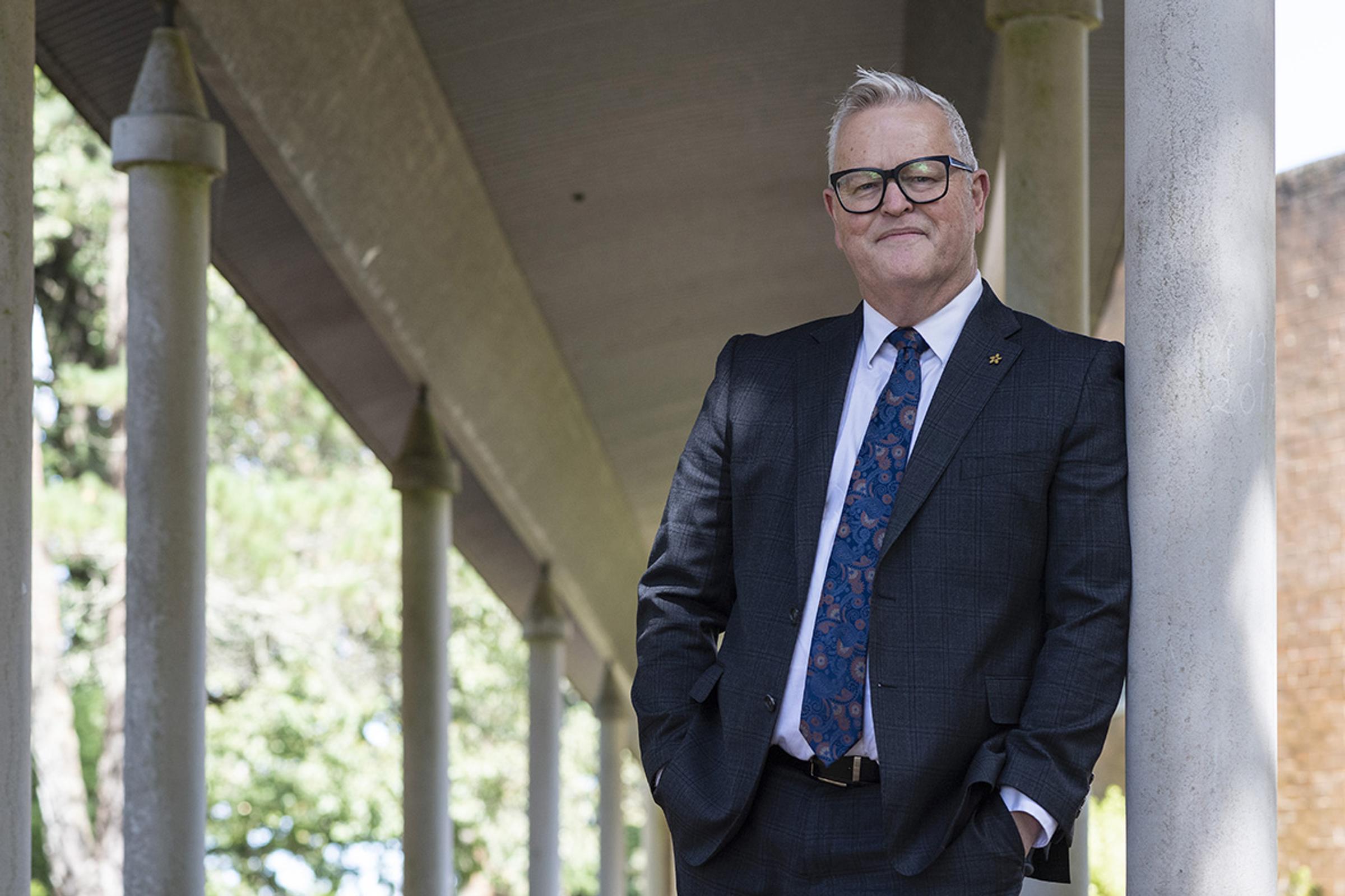
Dear Blue Mountains Grammar School Families,
As we approach the end of term, I wanted to take a moment to touch base with you while I am on sabbatical. Time away has provided space to think, to observe, and perhaps most importantly, to see more clearly the work we are doing together at Blue Mountains Grammar School.
Before I go on, I would like to acknowledge an important milestone currently in progress. Our school is amid our registration process with NSW Education Standards Authority (NESA). This registration is a requirement of every independent school in Australia every five years. Early indications from the feedback we have received from NESA have been very positive, which is encouraging affirmation of the work taking place across our school. My thanks go to our staff for the significant effort involved in preparing the required documentation, and in particular to our Deputy Principal, Owen Laffin, for his leadership in guiding this process. We will not know the outcome until August and of course we will keep you informed.
What Is Worth Learning?
While travelling, I have found myself returning to a question that sits quietly beneath much of what we do in schools: what is worth knowing?
In the 1800s, it is widely accepted that human knowledge doubled every 100 years. By the mid-20th century, that rate had accelerated to every 25 years. In more recent decades, estimates suggest knowledge has been doubling every 12 months. Now, research referenced by organisations such as IBM and the World Bank suggests that in some fields, knowledge may be doubling every twelve hours.
When I considered if that is even partially true, it raised a confronting but necessary question for me: who decides what makes it into a 150-page textbook?
Textbooks have served us well. They have been reliable, structured, and accessible repositories of knowledge. But they were designed for a different time, a time when knowledge was relatively stable, when what was printed could reasonably be expected to endure. In a world where knowledge is expanding and evolving at such a rapid pace, there is a growing risk that what is fixed on the page becomes outdated almost as quickly as it is published. Alongside that, updated editions are also at risk of suggesting that knowledge is fixed.
In medicine, not an abstract domain, but the field responsible for keeping human beings alive, it has been shown that medical knowledge was doubling every eight years before COVID. It is now doubling every seventy-eight days. The knowledge that will govern the treatment of a patient next year does not yet fully exist this year. The doctor who stops learning is not behind, but rather they are practising a different medicine from the one their patients need.
I believe the same principle applies to education.
This is not unique to medicine. It is the condition, to varying degrees, of virtually every domain that the young people in our school will enter including Law, Engineering, Finance, and Environmental Science. The jobs that a fifteen-year-old today will hold in their thirties may not yet exist. What is the future then for our students who are five? The problems they will be asked to solve have probably not yet been named. The knowledge they will need has likely not yet been generated.
If we are honest, much of the knowledge base of the past, while important, is no longer sufficient as a foundation for the future. This is not to diminish the importance of core skills. Reading, writing, comprehension, mathematical fluency, scientific understanding and an appreciation and experience of creative pursuits remain essential; they are the gateways to all other learning. But the model of education as primarily the transfer of static knowledge is becoming increasingly limited in its ability to prepare young people for the world they are a part of.
This is why it is so important that we look ahead, rather than simply refining what we have always done.
We have seen it recently in Australia. Tesla has just released its self driven car. I encourage you to go look at YouTube to see the reviews. As someone who has been driving for decades, the idea of sitting behind the wheel and not engaging with the driving process is foreign and, if I am honest, very scary. And yet people with more skill than me have deemed it appropriate that these cars are safe in any condition. In fact, some are saying that they will have a lower accident rate than human beings.
I wonder if my reluctance to believe that a self-driving car is a viable option, follows the same logic DNA of a model of schooling that is different to the one that we have always known. Could it be that like a self-driving car, there are other options that will get a student from point A to point B in their learning if we can only step towards it.
The question is no longer just what do students need to know? It is increasingly how do students learn, adapt, question, and create in a world where knowledge itself is constantly shifting?
Our task is not to abandon knowledge, but to rethink our relationship with it. To move beyond seeing it as something to be delivered, and instead to see it as something to be explored, challenged, and applied. To create environments where students are not only informed, but capable of navigating complexity, of thinking deeply, and of responding with creativity and courage. Ideally, we would be on the right trajectory if our students had space and opportunity to contribute to new knowledge, not just have it poured into them. An almost non-negotiable skill now is to possess the ability to know how to respond when the answer to a problem is not immediately apparent.
So perhaps the question we might hold as a community is this:
If knowledge is no longer fixed, what does it mean to be properly educated?
I remain deeply hopeful. I see in our students a capacity for curiosity, for ingenuity, and for courage. They are more than capable of stepping into this kind of learning. Our responsibility is to create the conditions in which they feel safe to do so, to take risks, to ask better questions, and to imagine new possibilities.
Thank you, as always, for your continued support of the school and of one another. I look forward to reconnecting with you all soon. I hope and pray that the term break is one that helps with a reset and a time to connect.
Warm regards
Steven Coote
Principal
This document has been reviewed for spelling and grammar. Please note that as such, it may identify some content as being generated by AI.
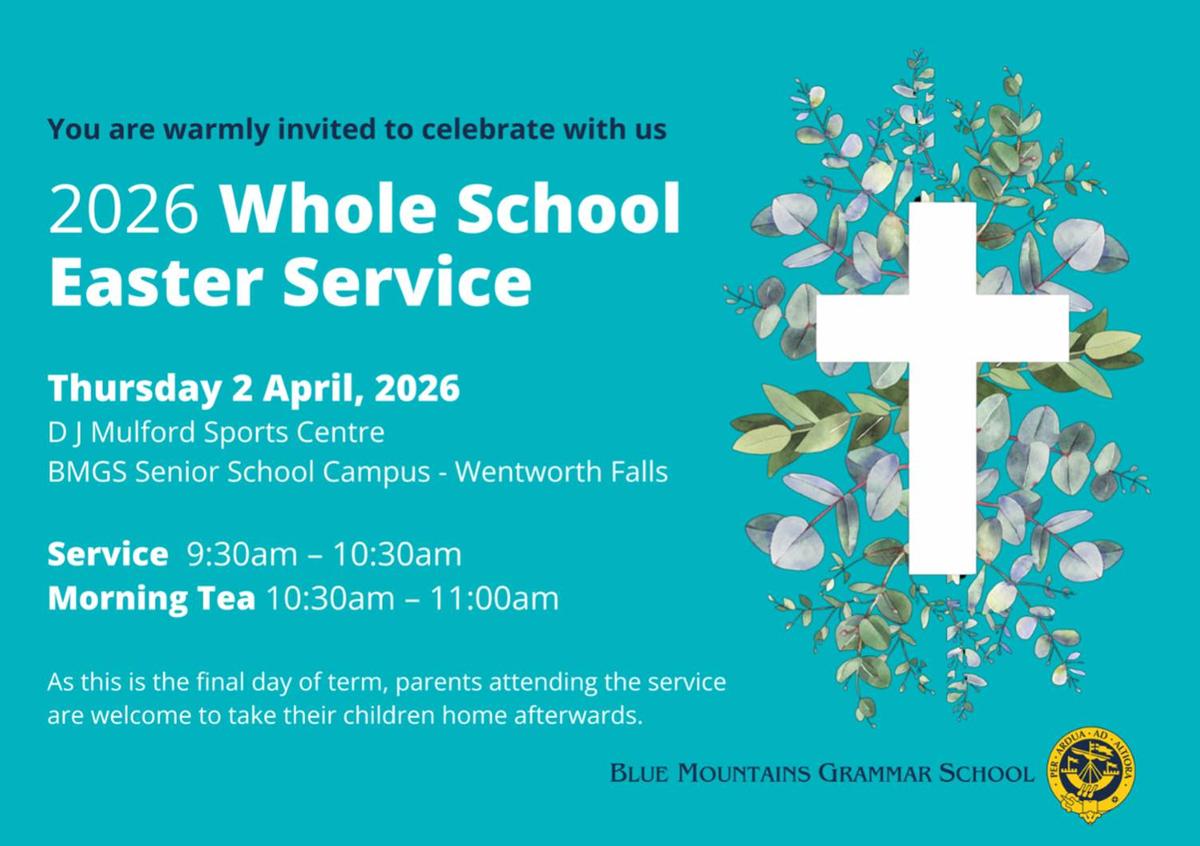
As this is the final day of term, parents attending the service are welcome to take their children home afterwards but we ask that the School be notified of this via the Schoolbox Portal, Future Absence feature or by sending an email to the relevant campus Reception.