
From the Leadership Team
In this update:
- Teaching and Learning update
- Transition week update
- Senior school key dates for 2026
- Preventing and Addressing Racism at GEC
- Multi-tiered System of Support for students
- Subschool Leadership for 2026
Teaching and Learning Update
The Cup Eve Curriculum Day was very productive for our teachers, who worked on creating subject overviews aligned with the new Victorian Curriculum 2.0 and the Victorian Teaching and Learning Model 2.0. Thank you to Daniel Bouchet-Hibbert for leading the day.
Sending big positive vibes to all students who have been sitting their Unit 3/4 exams, and thank you to their teachers, educational support staff and families for supporting them. We are almost there! Please encourage your young person to seek support from their Year 12 teachers. Each Year 12 teacher has five days off replacement classes prior to their exam period, during which they can offer additional support to their students.
GEC Working Bee 30th November 2pm to 4pm
As we approach the end of the year, we are planning a spruce-up of the school grounds. Paul McNeill has kindly offered to lead us in this venture once again. We will be doing some gardening and general tidying up around the school. The Working Bee will be held on Sunday 30th November, from 2 pm to 4 pm. Feel free to pop in for a bit or stay as long as you like. Please bring gardening gloves and a rake or broom if you have one. We will meet at the admin office. Everyone is welcome!
Transition Week Update
On 1st December, all students (Years 7 to 11) will transition to their next year level. Students in Years 11 and 12 in 2026 have one week of transition. Students in Years 8-10 in 2026 have two weeks of transition.
The 2026 Year 11 students (this year’s Year 10s) will move into the Learning Centre on 1st December, the first day of the transition week. They will have brand-new lockers with recessed locks.
Senior School 2026 key dates:
- Friday 1 May – Last day for VCE and scored VCE VET Unit 3-4 sequence enrolments
- Tuesday 16 June – General Achievement Test (GAT) held
- Monday 5 October to Sunday 1 November – Performance examinations, Languages oral examinations and Extended Investigation oral presentations held
- Thursday 15 October – Collaborative Curriculum and Assessment Framework for Languages (CCAFL) written examinations held
- Monday 26 October to Wednesday 18 November – VCE written examinations held
- Thursday 10 December – Final results released to students
Preventing and Addressing Racism at GEC
At Glen Eira College, we value the rich diversity of culture, language, background and belief within our school community. We are proud of the inclusive environment we have built, where every student is welcomed, supported and able to thrive.
Recognising and celebrating the strengths of our community helps us foster kindness, empathy and curiosity. We are committed to ensuring that every student feels safe, respected and able to engage fully in their learning.
Our teaching reflects the Glen Eira College values of Growth & Striving, Equity & Integrity, and Care & Respect, along with the Respectful Relationships framework, which supports students in understanding inclusion, building positive relationships and contributing to a supportive school environment.
To help us continue to make Glen Eira College a place where everyone feels welcome and respected, we encourage you to talk with your child about:
- the importance of celebrating diversity and supporting a multicultural school community
- the need for all members of our community to treat one another with respect and care.
Families are also reminded that our school values apply to all interactions within our school community.
You can find the GEC Communicating the Preventing and Addressing Racism in Schools Policy on our website.
For more information, you may find the Raising Children Network resource Racism: talking with children and teens, Raising Children Network.
Multi-Tiered System of Support (MTSS)
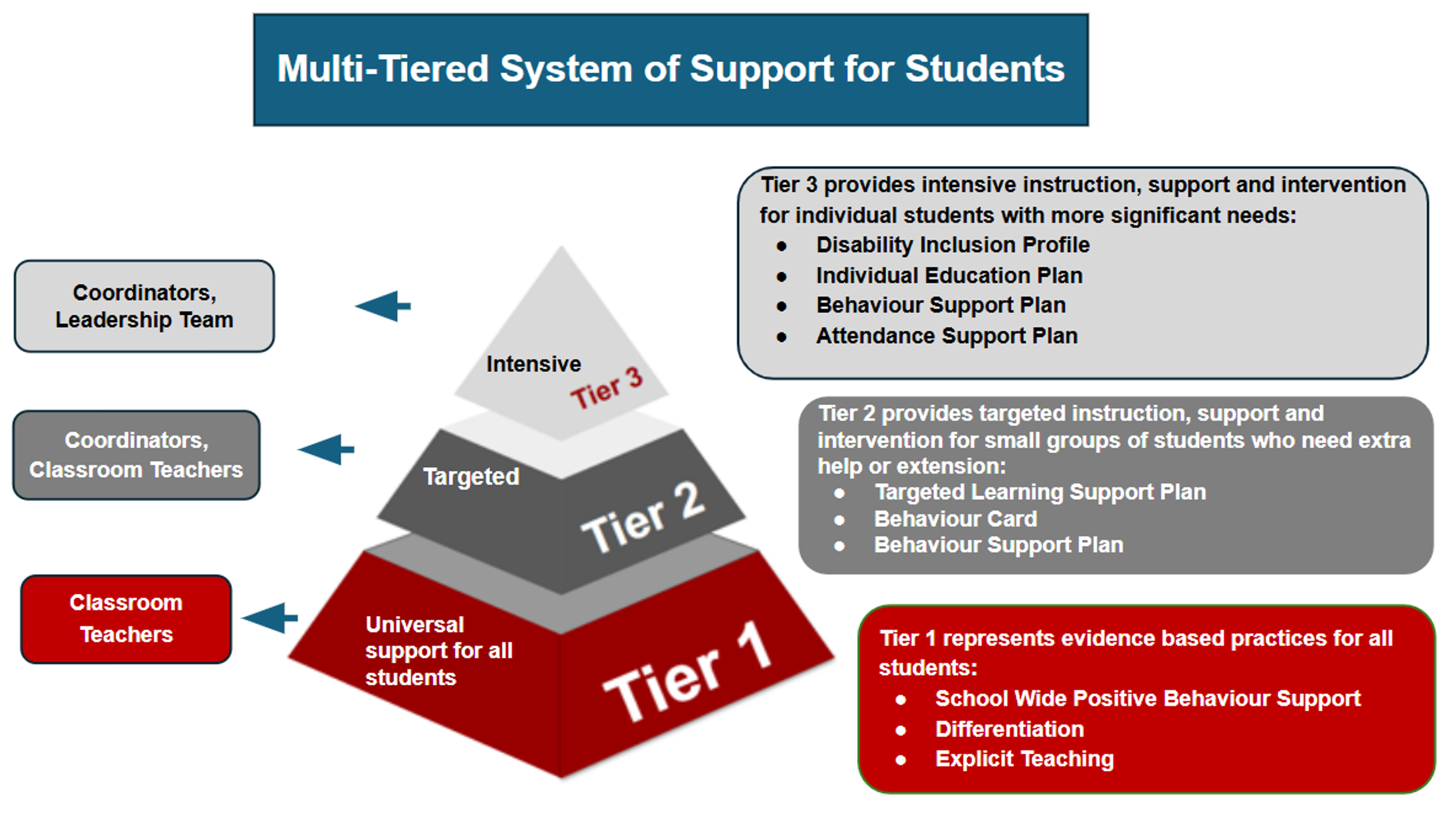
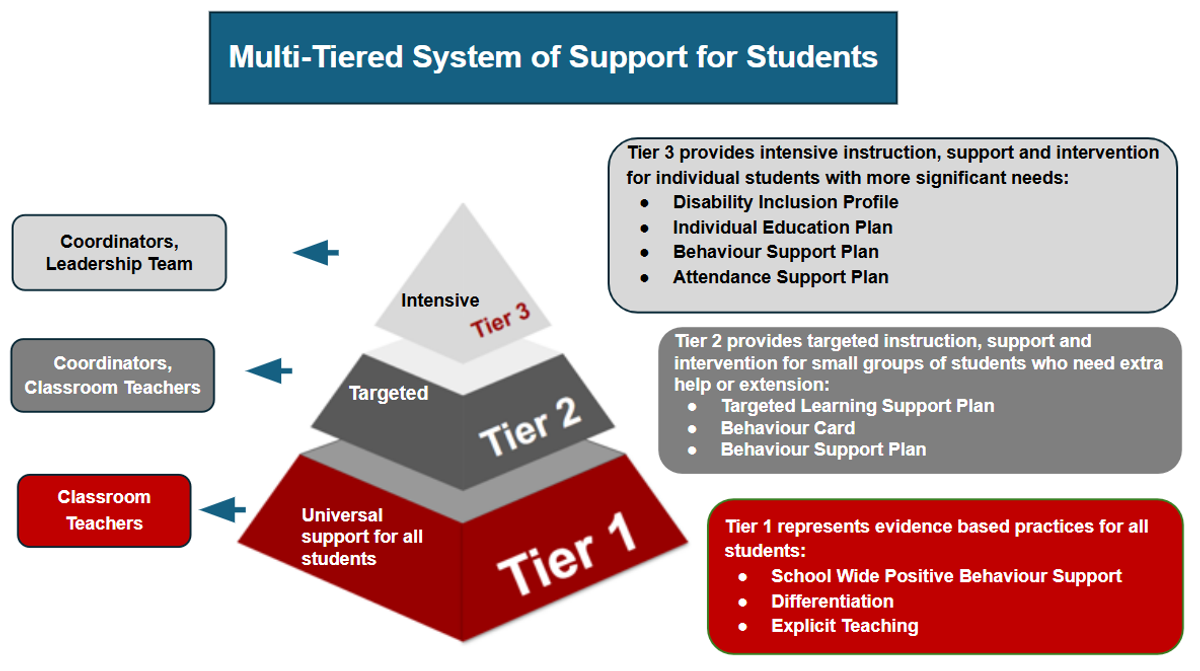
This term, Chizuko Inoue-Andersson has led the introduction of the Multi-Tiered System of Support (MTSS), an evidence-based framework designed to ensure all students receive the support they need to thrive.
MTSS includes a consistent approach to evidence-based instruction across the three tiers. It includes effective classroom practice at Tier 1 for all students as the foundation. Student learning, wellbeing and behaviour needs are addressed by increasing the intensity, frequency and duration of monitoring and support across the three tiers.
Data-based decision making is at the core of MTSS. With quality data, protocols and clear processes for collaboration, the whole school can participate in an agreed problem-solving approach for learning, wellbeing and behaviour. This includes identifying and monitoring students accessing interventions and extension, as well as reviewing and improving the effectiveness of each tier
Tier 1 Support for Students
Supports offered to all students include the School-Wide Positive Behaviour Support, differentiation, and explicit teaching.
Tier 2 Support for Students
This tier provides targeted support for students who are not funded but may require additional support. This can include a Targeted Support Plan, a Behaviour Card, or a Behaviour Support Plan. Support is coordinated through the Year Level Coordinators (YLCs). If your child requires any adjustments or accommodations, please contact the appropriate YLC to arrange a meeting with the relevant staff.
Targeted Learning Support Plan
A Targeted Support Plan can be created to assist students with diverse learning needs. It is used for understanding students’ learning strengths, barriers, and goals, and communicating specific pedagogical strategies to teachers. This form is completed by a staff member and/or coordinator in collaboration with the student, parents/carers can choose to attend the meeting.
Some non-funded students with additional needs may require an Individual Education Plan, for example, for special provisions at VCE or if their needs are not being met by the Tier 2 Support Plans, and students display significant functional limitations validated through assessment. The process for this is to email GEC supporting documentation from allied health professionals (e.g., doctors, speech pathologists, occupational therapists, psychiatrists, psychologists, etc.). The Inclusion Team will liaise with the family and the student to arrange a meeting to discuss and write an Individual Education Plan.
Behaviour Support Plan (BSP)
A Behaviour Support Plan (BSP) is a targeted document designed to address inappropriate, challenging or disruptive behaviour and guide students toward more positive actions. BSPs are created for students who have diagnosed behaviour disorders, have bullied or been bullied, or who need additional support for their wellbeing. These plans identify known triggers and the situations that may contribute to the behaviour, and outline strategies to reduce or remove these triggers. They also include proactive approaches to teach students alternative ways to meet their needs, guidance on how adults should respond to early warning signs without reinforcing the behaviour, and details on when and how the plan will be reviewed and evaluated.
Attendance
Teachers and our attendance team monitor absences daily and contact families if a student is away without notice. If attendance becomes a concern, Year Level Coordinators and Sub-School Leaders work with families to identify barriers and create a plan for improvement. For ongoing challenges, the leadership and wellbeing teams provide additional, tailored support. Together, we aim to help every student attend regularly and stay connected to their learning.
Attendance Support Plan (ASP)
An Attendance Support Plan is developed with the student, so they have ownership over the plan with the assistance of the parents/carers, student managers, learning support officers, and the wellbeing team.
Items addressed in the Student Support Group meeting to develop an Attendance Plan are:
- Strengths and interests of the student
- Attendance data and barriers to low attendance
- Attendance goals
- Actions
- Success Criteria
- Start and review dates
The attendance plan runs for a maximum of 10 weeks, in accordance with the Department of Education guidelines.
Late to School
Based on family feedback, we have changed the name of the YLC Detention to a YLC Check-in. The purpose of the 20-minute check-in is for the YLC to discuss with each student the reasons for their lateness and develop a plan to improve punctuality.
If your child is a diverse learner and you would like the YLC to check in at another time, or to arrange a meeting where you are present, please contact the YLC. Please note that as a parent/carer, you can approve lateness to school, which will then not attract a YLC check-in.
Tier 3 Support for Students
Our Disability and Inclusion students are supported through their Student Support Group (SSG) meetings, where their Department of Education plans are reviewed. These may include an Individual Education Plan (IEP), Behaviour Support Plan, and/or Attendance Support Plan.
Please continue to email supporting documentation from allied health professionals (e.g. doctors, speech pathologists, occupational therapists, psychiatrists, psychologists, etc.).
Subschool Leadership for 2026
Here’s a list of the relevant key contacts for the rest of 2025 and 2026.
Year Level | 2025 | 2026 (starting in transition 1/12/25) | ||||
| Year Level Coordinators | Year Level Coordinators | Subschool Leader | Assistant Principal | |||
7 | Dean West | Niketa Archer | Dean West | Patrick White | Niketa Archer | Loveena Narayanen |
8 | Thomas Balme | Jake Sherman | Daniel Lake | Jack James | ||
9 | Dalji Sandhu | Thomas Faulkner | Thomas Faulkner | Peipei Guan | David Juricevich | Sean Hogarth |
10 | Karen Eap | Daniel Lake | Dalji Sandhu | Stuart Plumridge | ||
11 | Elizabeth Tasiopoulos | Ting Pan | Elizabeth Tasiopoulos | Thomas Balme | Jeff Micallef | Mark Oudshoorn |
12 | Laura Brancatella | Laura Brancatella | Ting Pan | |||
We will continue to reflect on and adapt our processes, so some items may change. We will also aim to keep you informed throughout.
Jane Thornton and Chizuko Inoue-Andersson on behalf of the Leadership Team