Reflection
Christmas Gospel Reflection
If you were to give just a cursory glance at a collection of ‘religious’ Christmas cards, or even the local nativity scene, you would undoubtedly see a varied assortment of shepherds, wise men, livestock and angels gathered around the holy family in a timber structure of some sort. Even the most casual reading of Luke’s account of the birth of Christ would reveal that most of the nativity figurines are missing! Our retelling of the birth of Christ tends to be an amalgamation of the Luke and Matthew versions with a bit of creative tradition thrown in for good measure.
The Luke account of the nativity carries a very specific theology that runs throughout the rest of that gospel. It is a theology that places the outcast and downtrodden at the centre of Jesus’ mission. In this account, Jesus is born outside the town because there is no room for Joseph and Mary within the safety of the inn. Like those he will minister to later in life, Jesus is born ‘on the edge’ – even outside the boundaries. Rather than the impressive ‘Wise Men’ of the Matthew infancy account, the witnesses to Jesus’ birth in the Luke account are lowly shepherds. Unlike the somewhat romantic notion we may have of shepherds, in Jesus’ time they were regarded as little better than thieves and cut-throats. All they could be trusted to do was tend sheep outside of townships and away from ‘civilised’ society. They held one of the lowest positions in Jewish society. The gospel writer’s choice of these witnesses to the birth of Jesus is a very deliberate one that clearly announces the purpose and direction of Jesus’ mission.
Scriptural context – Matthew v Luke
Ask a child (or even most adults) to describe the scene at the birth of Jesus and you will hear a confused combination of the two scriptural accounts with several non-scriptural additions. It is a shame that the two versions have merged into one as each is deserving of its own integrity. The Matthew account emphasises Jesus as the fulfilment of prophecy and has Wise Men as the witnesses to his birth in a house. It is from Luke that we have the much humbler birth in a manger witnessed by the lowly shepherds. Each has something different and distinct to say about Jesus and his mission.
Gospel Focus – A Great Census?
The decree of a census for the whole Roman world appears to be an unlikely event. A census of people in local regions was not unusual but a census that required people to return to their place of birth carries no historical validity. The gospel writer correctly places Mary and Joseph in their home town of Nazareth but prophecy indicated the Messiah would be born in Bethlehem. The author needed an excuse for Mary and Joseph to travel to Bethlehem. We must remember that the gospels are not to be read as historical accounts but rather as faith accounts of the life of Jesus.
Historical Context – The Nativity scene
St Francis of Assisi is credited with setting up the first nativity scene and thus establishing a tradition that is carried on today in homes, churches and public spaces in Christian communities everywhere. In 1223, in the town of Greccio he created a life size tableau of the nativity scene to heighten the awareness of the celebration of the birth of Christ. It included statues of the holy family and a live ox and donkey. The inclusion of the livestock has no scriptural support and it is to Francis that we owe the array of sheep, oxen and donkeys that have become standard inclusions in our nativity scenes.
Questions for Adolescents
Q. What words or phrases from the passage appear to be particularly significant? Why?
Q. How might Mary and Joseph have felt about their situation for having their baby?
Q. What message about Jesus is portrayed by his mother laying him in a manger – an animal feed trough?
Q. Does a close reading of this passage change your picture of the birth of Jesus in any way?
Q. Why do you think the different infancy stories have been commonly combined into one?
Questions for Adults
Q. Why might the Luke gospel go into detail about the Roman officials at the time of the census?
Q. What is significant about Joseph being ‘of David’s House and line’?
Q. Why do you think the two infancy stories have been commonly combined into one?
Q. How could the two different infancy stories be better highlighted and respected?
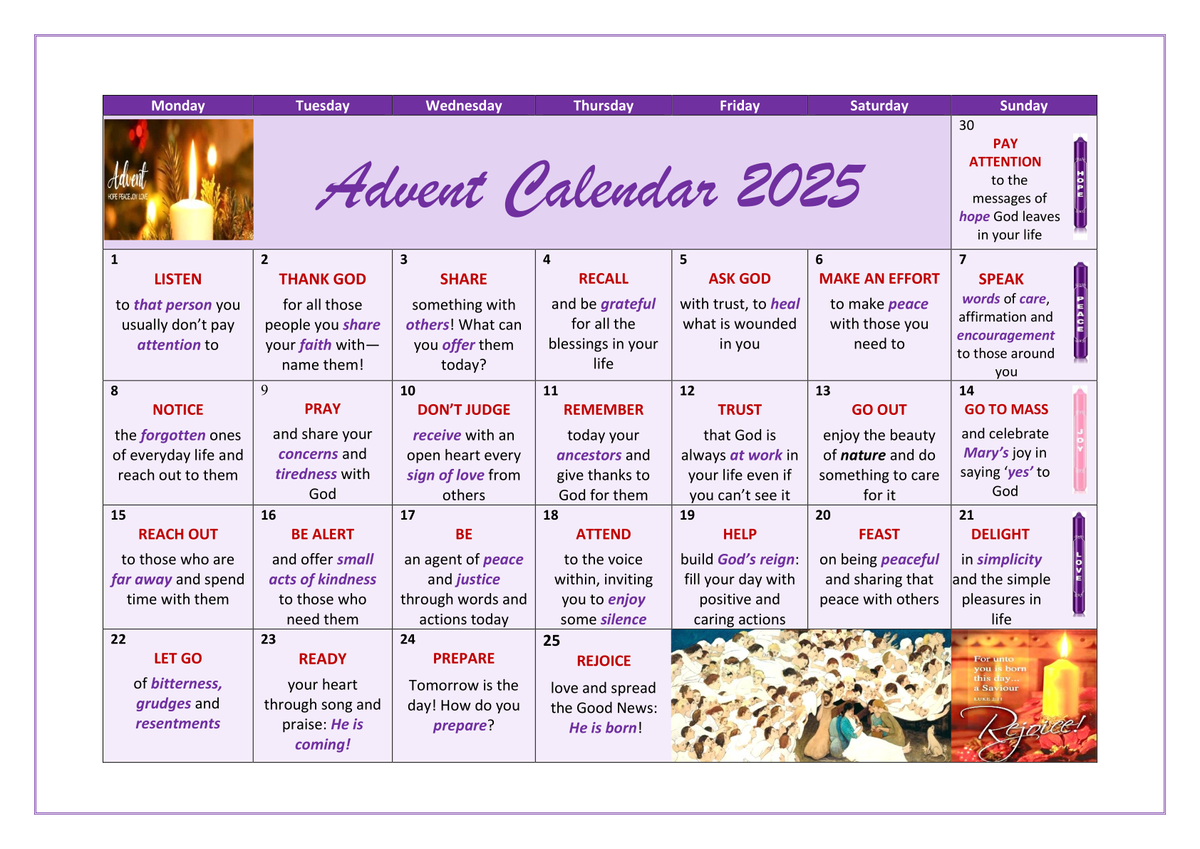
As we continue the season of Advent, please feel free to download this Advent Calendar which challenges and helps us navigate the season as we prepare for Christmas.