
Maths

There are 6 people at a party. They all shake each other’s hands once. How many handshakes are there altogether?
At an upcoming assembly, I’ll be demonstrating the classic “handshake problem". When I asked for predictions from our volunteers, answers ranged from 30, to 25, to 18… and even 10!
When you try to solve it without a clear strategy, it quickly becomes confusing. It’s very easy to double count. For example, if Person A shakes Person B’s hand, and then you later count Person B shaking Person A’s hand, that’s the same handshake counted twice.
So how do we solve it properly?
One way is to think about it person by person:
- Person A shakes hands with 5 other people.
- Person B has already shaken Person A’s hand, so now shakes 4 new people.
- Person C shakes 3 new people.
- Person D shakes 2 new people.
- Person E shakes 1 new person.
- Person F has already shaken everyone’s hand.
So the total is:
5 + 4 + 3 + 2 + 1 = 15 handshakes
We can also write it more efficiently as:
6 × 5 ÷ 2 = 15
And for our algebraically inclined, this can be generalised as:
n(n − 1) ÷ 2
where n represents the number of people in the room.
Drawing a diagram can also be useful when solving problems like this. In the hexagon diagram provided, each person (A–F) sits at a vertex, and each line joining two vertices represents a handshake. Seeing all the connections visually helps ensure that each handshake is counted once, and helps us to look for patterns.
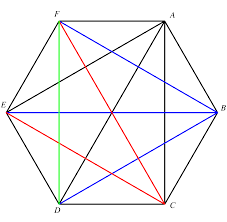
We’ll unpack the thinking behind it at assembly on Monday 2 March.
Kelvin Tang
Mathematics Learning Specialist