
Teens & Screens
Digital Habits - tips for parents/carers

Teens & Screens
Digital Habits - tips for parents/carers
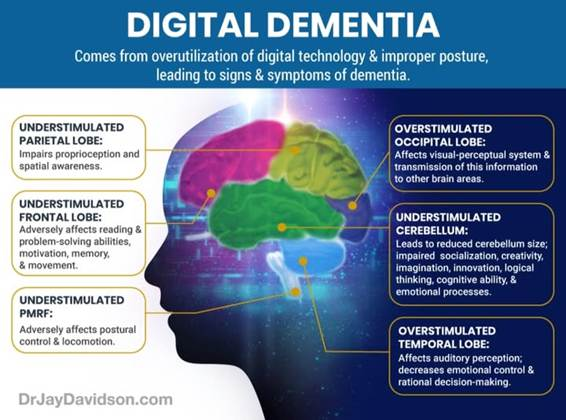
The impact of digital tools on brain function and cognition (the mental processes involved in gaining knowledge and comprehension through thought and experience) is a complex and intricate area of study that has prompted extensive research by researchers and experts. Digital media overuse influences and impacts brain development, especially cognitive and inhibitory control, attention, memory, and reasoning, essential for adapting to dynamic environments.
EFFECTS ON THE BRAIN:
Below are excerpts of the well documented findings as summarised in: https://www.frontiersin.org/journals/cognition/articles/10.3389/fcogn.2023.1203077/full

ATTENTION:
In this age of ‘interruption’, continuous partial attention is prevalent, referring to the state of continuously shifting one's attention across multiple tasks or stimuli without fully immersing oneself and only partially engaging in any one of them. This practice can lead to a superficial understanding of new information and a reduced ability to concentrate on any one task or piece of information. Consequences of continuous partial attention can be detrimental to cognitive performance and overall wellbeing and can lead to reduced productivity, decreased memory retention, and increased stress levels.
MEMORY:
When individuals rely on digital devices to store information, they are less likely to remember it over the long term, leading to memory loss. Studies indicate that overreliance on technology for even simple tasks can lead to decreased performance in memory recall. The constant barrage of information and distractions that come with digital technology can overload the brain, making it difficult to process information and retain it over time. One study reported an association between increased media multitasking and poorer working memory performance and lower academic outcomes.
ADDICTION:
Digital addiction is growing concern due to the widespread use of technology. Addiction can lead to changes in cognitive function, impacting the ability to think critically, remember important details, and make sound decisions, particularly in the area of risk assessment. The instant gratification (dopamine hits) and constant stimulation provided by technology can create a compulsive need for more. Addiction in the digital world can also impact social cognition, which refers to the ability to understand and interact with others, associated with decreased empathy, which is a vital component of social cognition. Research has shown that excessive digital use, particularly related to activities such as social media and gaming, can trigger addictive behaviours by activating the brain's reward circuitry.
NOVELTY-SEEKING AND PERCEPTION:
Novelty seeking is a fundamental aspect of cognition associated with exploration, curiosity, and the desire for new experiences. The digital world offers an abundance of novel stimuli. On one hand, this fosters curiosity and broadens intellectual horizons. However, the overload of novel information can lead to cognitive fatigue and a skewed perception of reality due to the selection and amplification of certain types of content. It is still critical to note that excessive novelty seeking in the digital realm may lead to a constant search for new stimuli, potentially detracting from focused and sustained learning. It can also contribute to information overload, reduced depth of understanding, and difficulties in maintaining attention and self-regulation.
DECISION MAKING:
Increasing internet usage has led to more informed decision making due to a broader range of accessible data. However, the overwhelming volume of information available can lead to information overload, complicating the decision-making process and potentially causing decision paralysis. In one study conducted back in 2012, participants who spent more time on social networking sites showed a higher level of cognitive overload, leading to a decrease in their ability to make decisions. Algorithms can streamline decision making by providing tailored options, but they can also lead to cognitive biases. These biases, in turn, can reduce exposure to diverse perspectives, leading to sub-optimal decisions and perpetuating confirmation bias.
CRITICAL THINKING AND LEARNING ABILITIES:
Excessive digital media use is associated with poorer cognitive control, including attention and inhibitory control. It is also linked to disrupted sleep patterns, which can also affect learning, particularly if devices are used at bedtime, leading to increased daytime sleepiness, which can impair cognitive function and academic performance. Artificial Intelligence (AI) can aid cognitive tasks to enhance human capabilities. However, here is a potential risk that over-reliance on AI for decision-making could diminish human capacity for critical thinking. Young people need opportunities to tackle challenges and learn skills to solve problems independently, a process that can be circumvented by AI, potentially affecting the development of these skills.
Final Thought from Harvard University from ‘The Screen Time Brain’
“The growing human brain is constantly building neural connections while pruning away less-used ones, and digital media use plays an active role in that process. Children need a diverse menu of online and offline experiences, including the chance to let their minds wander. Boredom is the space in which creativity and imagination happen.” https://hms.harvard.edu/news-events/publications-archive/brain/screen-time-brain
Tanya Moran
Leader of Professional Practice