Teaching and Learning

Learning Habits Rubric
Our College is in the process of reviewing the Academic Progress Policy, as indicated in the previous newsletter edition. As a key part of this, the Learning Habits Rubric requires updating to ensure that it is both current and reflective of our expectations of students.
The updated rubric is below and also available here. Several features of note are;
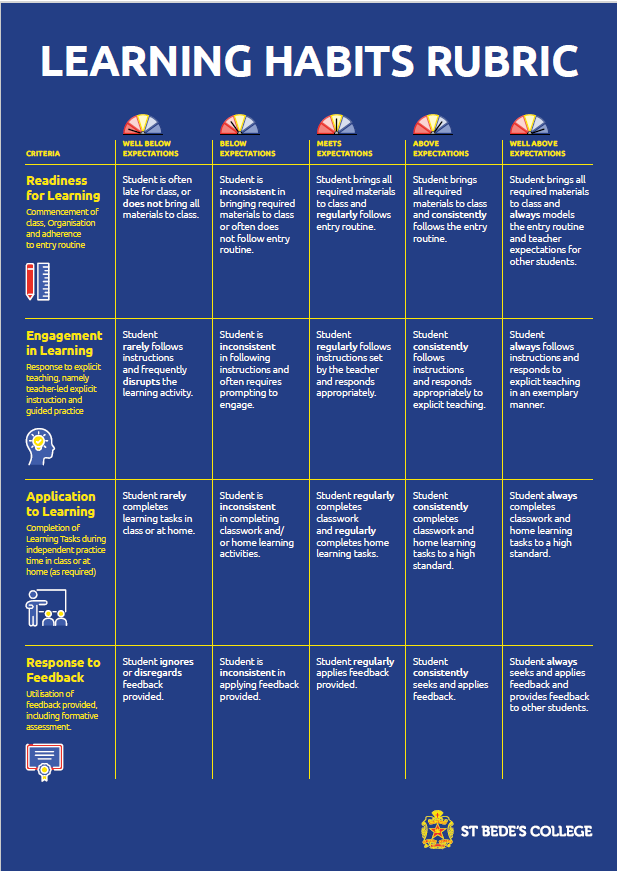
The Standards: Having clear expectations of students for students is vital in order for them to improve and grow. In labelling behaviours in relation to what degree the student meets expectations makes them explicit to students.
The Focus Areas: Whilst readiness, engagement, application and response to feedback are the names of each of the criteria, they also reflect the College’s Pedagogical Charter. In summary, the focus areas involve;
- Being organised and on time, as well as following an entry routine, ensures that the appropriate learning environment is established from the commencement of the period.
- Following teacher instruction when either direct instruction or guided practice are taking place- two elements of the explicit instruction teaching model- allow the student to engage in the learning with specific skills and knowledge modelled
- When asked to work independently, students are able to focus on what they are supposed to be doing, increasing the likelihood that the necessary skills and knowledge become embedded, and
- When given feedback from a teacher or peer, the student uses that feedback in order to improve on what they have previously done.
Frequency: Making assessments based on how often a student exhibits a particular behaviour is linked to the notion of habit-forming. Using terms such as ‘rarely’, ‘regularly’, ‘consistently’ (or inconsistently) and ‘always’ reflects a personal standard that students set for themselves. The positive behaviours are encouraged and reinforced, whilst that others are undesirable (such as often being late to class, for example) are identified as not meeting expectations. Highlighting these to the student ensures they pay attention to them and work to make a change for the better.
The use of the rubric remains the same. Every teacher of every student in every one of their classes will report against it towards the end of each term. Assessments that are ‘well below’ or ‘below’ expectations are seen as negative learning habits, whilst those that are ‘above’ or ‘well above’ are seen as positive. The students then receive an indication of what percentage of learning habits assessments are positive and what percentage are negative; these are then reported each term.
As indicated, the Academic Progress Policy is being finalised. Once complete, it will be made available for students and families.
Brenden Mair
Deputy Principal - Teaching and Learning