Principal's Report
- Tania Sorbello

Principal's Report
- Tania Sorbello
It’s already Week 4 and so much is happening here at FNPS! A huge thank you to Ben and of all the staff and community members involved in organising and running last Thursday’s Year 4-6 Swimming Carnival. It was such a wonderful event that brought together students, staff, and the entire community. The atmosphere was electric, and it was a fantastic opportunity for everyone to participate, cheer, and celebrate the spirit of FNPS.
Congratulations to all of the competitors; your effort, sportsmanship, and team spirit truly shone throughout the day. We wish all the best to those students moving forward to represent FNPS at the upcoming District Carnival.
Once again, thank you to everyone who helped make the Swimming Carnival such a memorable occasion. It was a fantastic day, and we are grateful to all who contributed to its success!
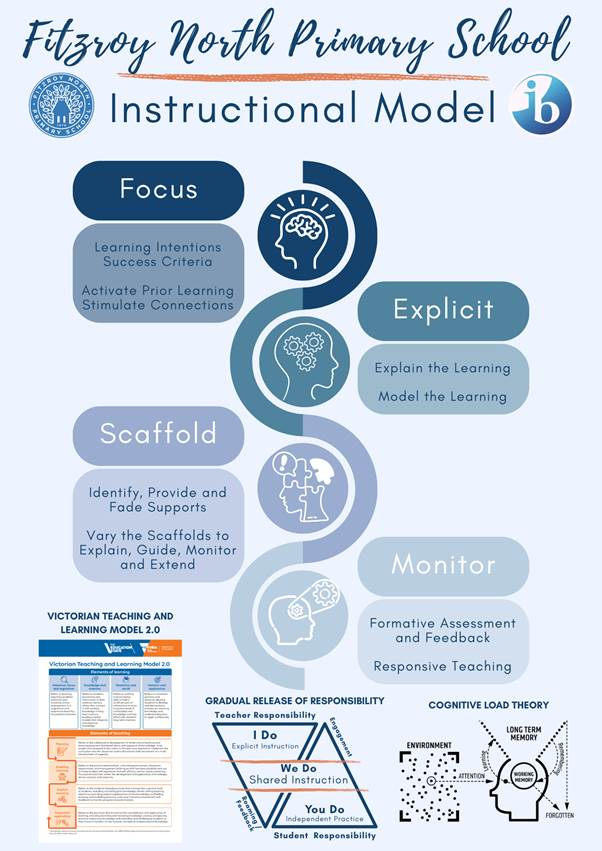
In 2025, Fitzroy North Primary School undertook a comprehensive review of our Instructional Model to ensure that our teaching practices continue to meet the diverse and evolving learning needs of our students. This review was guided by a clear question: What does the research tell us about how children learn best, and how can we reflect this consistently in every classroom?
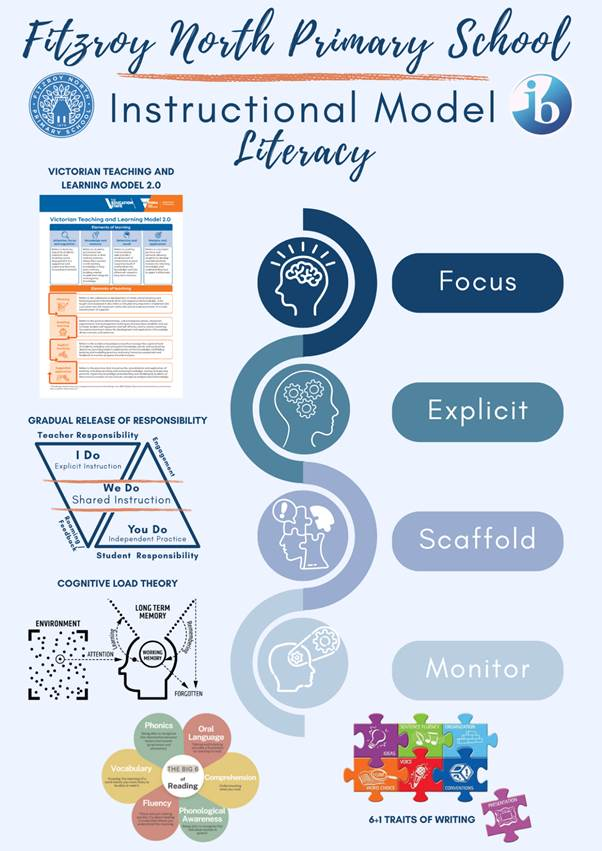
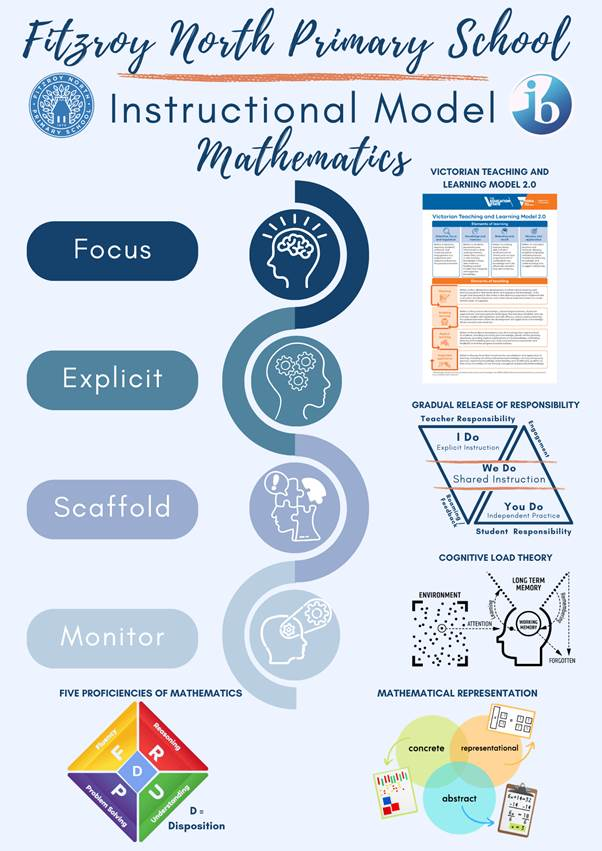
The result is our refreshed FNPS Instructional Model, a clear and shared approach to teaching and learning that is grounded in contemporary research on how students learn, develop understanding, and build long-term knowledge. The model reflects best pedagogical practice, including explicit teaching, purposeful scaffolding, formative assessment, and responsive instruction, all underpinned by an understanding of cognitive load theory and the gradual release of responsibility from teacher to learner.
Importantly, the FNPS Instructional Model is strongly aligned with the Victorian Teaching and Learning Model 2.0 (VTLM 2.0) and the Victorian Curriculum 2.0, ensuring that our classroom practice reflects both state expectations and evidence-based approaches to high-quality teaching. This alignment supports clarity for teachers, consistency for students, and confidence for families that learning at FNPS is intentional, structured, and responsive.
To further strengthen teaching in key learning areas, the school has also developed accompanying Instructional Models for Literacy and Mathematics. These models draw on current research specific to these core curriculum areas and provide additional guidance to support effective instruction, differentiation, and assessment.
Together, these models support our shared commitment to excellence in teaching and learning and help ensure that every FNPS student is supported to thrive, grow, and succeed.
In 2026, staff will engage in targeted professional learning to ensure these Instructional Models are implemented with shared understanding and fidelity across the school.
The models are attached below for your information.
A reminder that the Welcome Picnic will be held Thursday 26th February from 3:45pm – 6pm on The Block. An assembly will be held at 3pm, where our newest little learners will take part in a special ceremony with their Year 6 buddies. Make sure to come along and be a part of these special events.
There have been an increasing number of students arriving at school quite early each morning. Please be advised that staff supervision begins at 8:45am and children are not supervised in the yard before this time. We ask that parents and carers ensure students are not left unsupervised before official supervision begins.
This is also a reminder to families that, in the interests of keeping your children safe, we ask that you do not double park during drop-off or pick-up times. Double parking causes congestion on the street and creates blind spots for children and families attempting to cross the road. Whilst I understand the difficulties around parking in our area, accidents can inadvertently happen in the blink of an eye, so I ask that all families refrain from this activity.
A huge congratulations to our wonderful Stephanie Alexander Kitchen Garden teacher, Lucy Ballard, along with the dedicated community members of our FNPS Sustainability Team: Tan All, Eve France and Victoria Beneragama, and our student Environmental School Improvement Team on their recent shout out in the Yarra Environment News communications.
We are incredibly grateful for their passion, expertise and ongoing commitment to sustainability at FNPS. Their work not only enriches learning opportunities for our students, but also strengthens our whole-school approach to environmental responsibility. This collective effort is an important part of our journey as we strive towards accreditation as a ResourceSmart School.
A link to the article can be found here: Yarra Environment News
For many children, the beginning of the school year can mean reconnecting with friends; sharing tales of holiday adventures and slipping back into the routine of learning. For many other children, however, this return to school can bring with it heightened levels of anxiety and trepidation about the year ahead. Below is a great article from the Happy Families website, discussing the manifestation of this anxiety and the ways in which we can support our children to thrive at school each and every day.

As the first day of school edges closer, we get busy organising school uniforms, picking up book orders and sorting out art supplies. There are new shoes to buy and after-school activities to plan. It’s exhausting, and expensive, but for many families it’s also exciting.
Parents feel anticipation. We get our lives back (at least a bit) once the kids are back at school. It means relief!
Our children don’t always feel as positive as we do though. Many kids experience anxiety – sometimes profoundly – with fears about new classes and teachers, or maybe even new schools and friends.
Anxiety can be hard to recognise in our children. They don’t typically say, “Mum, I’m feeling genuine and deep fear about going to school next week.” For a start, they’re typically not that ‘verbal’, preferring to keep their fears to themselves. Secondly, they may not actually recognise what they’re feeling. As parents, our job is to watch for signs of anxiety so we can coach and support our children.
What does anxiety ‘look’ like? Sometimes it can look like illness. ‘I don’t feel well’, or ‘My tummy hurts’, are common complaints. Unfortunately too many parents accuse their children of being hypochondriacs rather than understanding the source of their pain.
Other times it can show in the form of defiant or angry behaviour. Our child acts out, argues, and creates conflict – at home or at school. We think they’ve got an attitude problem or a behavioural problem, but they’re actually worried and don’t know how else to show it except via anti-social outbursts. And then we get them in trouble!
Whatever form anxiety takes, anxious thoughts are actually a sign of a brain that is doing its job. We are wired to keep ourselves safe. Anxious thoughts are the brain’s way of saying, ‘You might be in danger’. When our brain identifies a threat – real or otherwise – our fight or flight response is triggered. Our bodies are flooded with neurochemicals that build anxiety. It all comes from feeling unsafe. Whether the danger is real or not is entirely irrelevant.
When it comes to school anxiety, we may feel that our child is safe. But we don’t know what they know. They may be fearful of a teacher, a fellow student, or simply being away from us. It could be the school yard, the school bus, or the toilet block. Telling them, ‘You’ll be right. Don’t worry about it. Stop being so silly’, is not going to help them overcome their anxiety.
Instead, I recommend the following:
Name It
My favourite saying on this topic is “If you can name it you can tame it.” Talk to your child about what anxiety is, how it makes you feel and where it comes from. Research shows that putting feelings into words can disrupt the brain’s anxiety instincts and alleviate negative emotional responses.
But timing is everything. As emotions go up, intelligence goes down. Talking about things in the middle of an anxious moment won’t help. Wait for a time when your child is calm and open to conversation. Then speak to them in a way they can understand about why they feel anxious. Explain that their brain is simply trying to protect them. Tell them that it is normal to feel this way and that there are ways they can help themselves to feel better.
Brave Thoughts
Brisbane psychologist, Karen Young, says kids should use brave thinking to replace negative thinking. We need to teach our kids that when anxious thoughts are occupying our brain, there’s no room for other happy thoughts – they’re crowded out.
But we can replace anxious thoughts with brave thoughts. ‘Brave thoughts (‘I can do this.’) lead to brave behaviour. Calm thoughts (‘Breathe in… breathe out.’) lead to calm behaviour’, Karen says. Encourage them to talk back to their anxious brain, with brave thinking.
Provide Practical Support
Sometimes our anxious kids may still need a little bit of practical support from mum and dad as well.
Think about your child’s individual worries and brainstorm (with their input) ways to tackle those worries. If your child is starting a new school, help them become familiar with the school before starting – take a tour, meet the teacher and see where the facilities are. Or, if your child is worried about seeing friends, organise a playdate for the week or two before so they have a chance to reignite friendships.
It also helps to get back into the routine of school at least a week in advance. Take some time to work out all the worries about uniforms, and how to pack their backpack and lunch boxes.
Shower Them With Love
The last and best thing you can do for your anxious child is to show them love. Love is associated with reduced depression and anxiety, and it’s an easy thing to do for our kids.
To combat first day anxiety you could put a small toy in their backpack that has a kiss on it, or give them a kiss for each hand to take with them. You could write funny notes on their lunch bag or pop a little picture of yourself in their backpack. It could be any little token that helps them to feel safe and brave and loved.
Understand
Finally, be understanding. Don’t dismiss or disapprove of the anxious feelings, even if they seem to be sticking around. Being brave takes time. Back to school anxiety is very real and can be paralysing. But it doesn’t have to be. Name it, explain it, teach brave thoughts, and always, always give love and you’ll find anxiety significantly decreases (for your kids and you)!
For more articles and practical tips on supporting children, head to Happy Families - Resources and Advice
Go gently,
Tania