Teaching & Learning Report
Steven Sirrals

Teaching & Learning Report
Steven Sirrals
Ongoing Commitment to Teaching Excellence
At our Woodmans Hill Secondary College, we’ve always taken great pride in the way our Teachers, Education Support (ES) staff and tutors connect with and support our students.
You see it every day in the classroom — Teachers and ES staff who know when to move from modelling new learning, through to shared examples, then into independent practice, knowing who needs extra support as they do this.
Next term, our staff will spend some dedicated time to dive even deeper into the "Science of Learning" to revisit some of our previous Professional Learning, refining those already existing skills, and exploring further into the practice of scaffolding.
Our latest Professional Learning session focused on the "Gradual Release of Responsibility and advanced Scaffolding"—essentially, the art of moving a student from "I can't do this yet" to "I can do this all by myself."
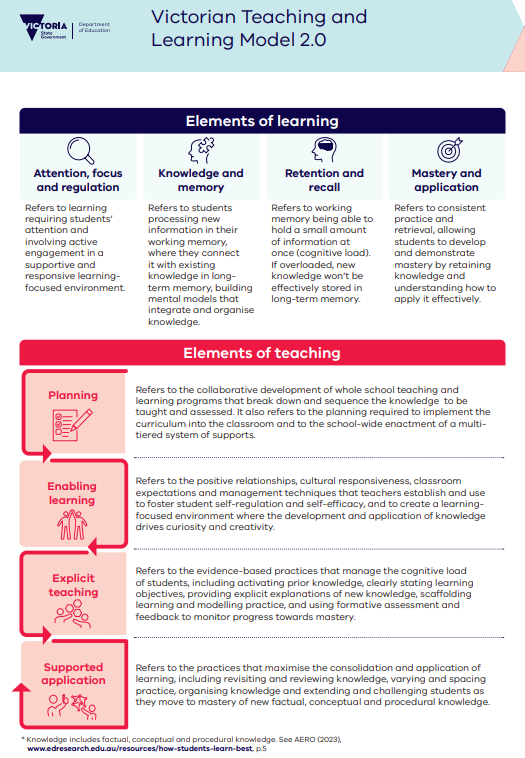
In the context of Explicit Instruction, scaffolding is the temporary support system a teacher builds around a student to help them reach a learning goal they couldn't achieve alone.
Think of it exactly like the scaffolding on a building: it is essential during the construction phase to provide safety and access to high places, but it is always intended to be temporary and removable.
How Scaffolding Works in Practice
In our classrooms, our teachers use scaffolding to bridge the gap between a student's current ability and the requirements of a new task, as our staff are already skilled in identifying needs and they apply these "supports" strategically:
Front-Loading Vocabulary: Providing the 'key words' before a reading task so the student doesn't get stuck on definitions.
Graphic Organizers: Using visual maps or frames to help students organize their thoughts before they begin writing.
Sentence Starters: Giving students the first few words of a complex response to help them overcome "blank page" anxiety.
Building on a Strong Foundation of Learning
As mentioned, we will spend the morning of the upcoming Professional Learning Day revisiting some of our previous learning from the last few years. This spaced practice approach, allows us to ensure there is greater consistency between classrooms and also ensure new staff to Woodmans Hill Secondary College, have an opportunity to engage with the theory and learning which underpins the teaching here at Woodmans Hill Secondary College.
We will focus on:
Cognitive Load Theory: Understanding how much new information a student’s "working memory" can hold at once. By being mindful of this, we ensure students don't feel overwhelmed or "short-circuit" during a tough lesson. We revisit how to ensure we help students recall previously understood knowledge.
Checking for Understanding: Using quick, effective checks throughout a lesson to ensure every student is on track before the class moves forward together, or determining if students need extra support.
Chunking New Information: Breaking down big, sometimes complex concepts into bite-sized, manageable pieces. This helps students master one step before moving confidently to the next.
Think Alouds: By verbalizing their own thought processes, our teachers model the internal "inner monologue" that successful learners use to solve problems. Students can then replicate this as they solve the problem/complete the task.
The "I Do, We Do, You Do" Approach
The heart of our session will be refining the Gradual Release model. While this is already a staple in our classrooms, we looked at new ways to provide "scaffolds"—temporary supports like graphic organizers, sentence starters, or visual cues—that we can gradually remove as a student gains confidence.
The goal is simple: to provide a safety net that is strong enough to support them, but flexible enough to let them move on independently with the learning when they are ready.
What This Means for Your Child
When teachers have the time to sharpen these tools, the result is a classroom where students feel more capable and less frustrated. You might notice your child feeling more empowered to tackle homework independently or explaining a concept to you using the same "Think Aloud" strategies they saw in class.
We are incredibly proud of our staff’s dedication to being lifelong learners. By staying at the forefront of educational research, we ensure that your children aren't just learning—they are thriving.
Learning Walks
The leadership team is currently conducting Learning Walks (LW) during lessons. The purpose of Learning Walks is to gather data on the implementation and effectiveness on key focuses of our work.
This Semester, our focuses are on:
Call to attention – teachers use a common signal to transition a class from an activity or talk to being ready to listen.
Low Level interventions – teachers use subtle and proactive strategies to manage a classroom without disrupting the flow of a lesson. They are designed to address minor off-task behaviors before they escalate into major distractions.
Scaffolding - teachers use scaffolding to bridge the gap between a student's current ability and the learning for a new task.
Assessment
NAPLAN has finished!
As you will be aware, the first day of NAPLAN had complications due to the NATIONWIDE technical issues. Our students and staff adapted to this incredibly well on the day. With a slight change to the NAPLAN sessions, the remainder of the tests went really well.
Well done to Tim Ross and Stef Sharkey for their organisation and all the teachers and ES staff who worked with students to support them during their NAPLAN sessions.
Across the board, student behaviour was really good and students continually tried their best. Parents will receive their child's NAPLAN results later in the year.