
Learning & Teaching News
Starting Strong and Staying Balanced in VCE and VCE-VM
A strong, steady start to Term 1 sets students up for success across both VCE and VCE-VM, and parents play a vital role in shaping those early habits. When families encourage a balanced routine from the beginning – consistent study, predictable rest, and time for sleep and exercise – students are more likely to stay engaged and resilient across the year (Victorian Curriculum and Assessment Authority [VCAA], 2025; St Francis Catholic College, 2025).
Research in learning and cognitive psychology shows that scheduled rest is not wasted time; it is part of how the brain learns. A study supported by the US National Institutes of Health found that when people take short breaks while practising a new skill, their brains “replay” what they just did, which strengthens memory and improves later performance (National Institutes of Health, 2025). In other words, breaks are when the brain consolidates learning, rather than simply pausing it. Recent work on “micro-breaks” – very short, regular pauses – shows that these breaks can sustain attention and stabilise performance over the course of a lesson, preventing the typical slide in concentration we see when students work without stopping (Bourdeau et al., 2025; Fronda et al., 2025). This is especially important in senior secondary years, where cognitive demands are high and students are managing multiple subjects (VCAA, 2025).
There is also growing evidence that the type of break matters. Brief “active breaks” – such as stretching, walking, or a short movement-based activity – have been linked with better decision-making, improved focus and greater psychological resilience (Gupta & Lee, 2025). Purposeful breaks of 5–20 minutes, where students step away from screens, move their bodies, or engage in a calming activity, can increase energy, productivity and ability to focus once they return to study (Hoben & Saxby, 2023; Cornell Health, 2016). In contrast, scrolling social media rarely provides true rest and can leave students more distracted when they return to their books (Cornell Health, 2016).
For VCE and VCE-VM students, a simple pattern can help: work in focused blocks (for example, 25–40 minutes on a single task) followed by a short, planned break (Victoria University, 2024; Cornell Health, 2016). Parents can support this by helping students set up a visible daily plan that includes blocks for coursework, scheduled breaks, and protected time for sleep and exercise (St Francis Catholic College, 2025; Victoria University, 2024). Local wellbeing advice for VCE students emphasises that regular breaks, physical activity and staying connected with friends and family all contribute to better mental health and more sustainable effort over the year (Victoria University, 2024; VCAA, 2025). Good-quality sleep – ideally around eight hours per night – then supports memory consolidation and emotional regulation, making the next day’s study more effective (St Francis Catholic College, 2025).
As Term 1 gets underway, families can encourage students to “start strong” not by doing everything at once, but by building the right habits early: consistent coursework, realistic goals, and deliberate rest. Scheduled breaks, active downtime and regular sleep are not signs that a student is taking VCE or VCE-VM less seriously; they are evidence that they are approaching their final years of schooling in a healthy, research-informed way that can sustain them all the way to the end of the year (National Institutes of Health, 2025; St Francis Catholic College, 2025; Zacher & Rudolph, 2022).
References
Bourdeau, C., Smith, J., & Nguyen, T. (2025). Sustaining student concentration: The effectiveness of micro-breaks in classroom settings. Frontiers in Psychology, 16, Article 1589411.
Cornell Health. (2016, September 30). Study breaks & stress-busters. Cornell University. https://health.cornell.edu/about/news/study-breaks-stress-busters
Fronda, M., Li, Y., & Carter, L. (2025). Sustaining student concentration: The effectiveness of micro-breaks during academic tasks. Journal of Educational Psychology, 117(4), 512–526.
Gupta, R., & Lee, S. (2025). Enhancing academic performance, cognitive functions, and resilience through active breaks. Cognitive Psychology Review, 29(3), 201–219.
Hoben, A., & Saxby, T. (2023). Breaks and productivity: An exploratory analysis. Journal of Occupational Health Psychology, 28(2), 145–160.
National Institutes of Health. (2025, March 31). Study shows how taking short breaks may help our brains learn new skills. https://www.nih.gov/news-events/news-releases/study-shows-how-taking-short-breaks-may-help-our-brains-learn-new-skills
St Francis Catholic College. (2025). Preparing for VCE success: A guide for students and families [PDF].
Victoria University. (2024, July 17). Mental health tips for VCE students: Staying calm & confident during exam time. Victoria University.
Victorian Curriculum and Assessment Authority. (2025, March 4). Health and wellbeing. VCAA. https://www.vcaa.vic.edu.au/student-guides/get-vet/health-and-wellbeing
Zacher, H., & Rudolph, C. W. (2022). “Give me a break!” A systematic review and meta-analysis on the effects of breaks on well-being and performance. Journal of Applied Psychology, 107(6), 925–947.
Irene Balder
Senior Years Curriculum Leader, Cranbourne Campus
VCE SHOWCASE: Unit 3&4 Product Design - Stella Ploudias, 2025 Year 12 Graduate

In VCE Product Design, students are challenged to respond to a design brief through research, experimentation, prototyping and refined construction. It is a rigorous process that demands creativity, technical skill and sustained problem-solving. Stella’s major project last year exemplified this depth of learning, and I am proud to share her reflections below on the inspiration, challenges and growth that shaped her work.
What first sparked the idea for your Product Design project?
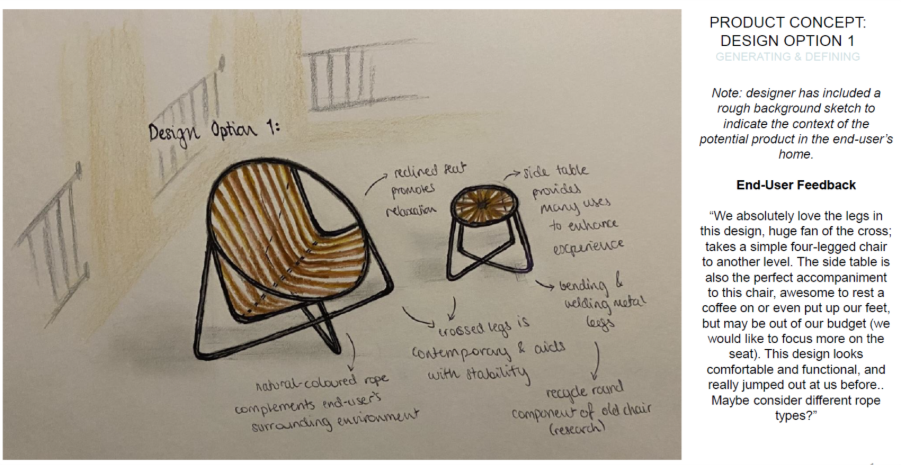
The central focus for this design project was ‘sustainability’, and I’ve always loved the concept of upcycling, so I kept my eyes peeled for things I could reuse to create something new. In the end, I revolved the project around the use of old spools of used marine rope, which is a thick and extremely durable material that fit right in with the project scope. I wanted to challenge myself by using weaving techniques to incorporate the rope, and enjoyed the relaxed, beach aesthetic it brought to products.
Was there a particular problem, experience, or person that influenced your design?
People putting perfectly good furniture out on street curbs waiting for hard rubbish is something I have never enjoyed seeing. I’ve always found a purpose in those things, and this largely influenced my design. With Mr. Gardiner’s help, I was able to get an old outdoor chair (which was ready to be thrown out) in to school to use as structural inspiration and materials testing for my product.
Did you have to problem-solve or redesign anything along the way?
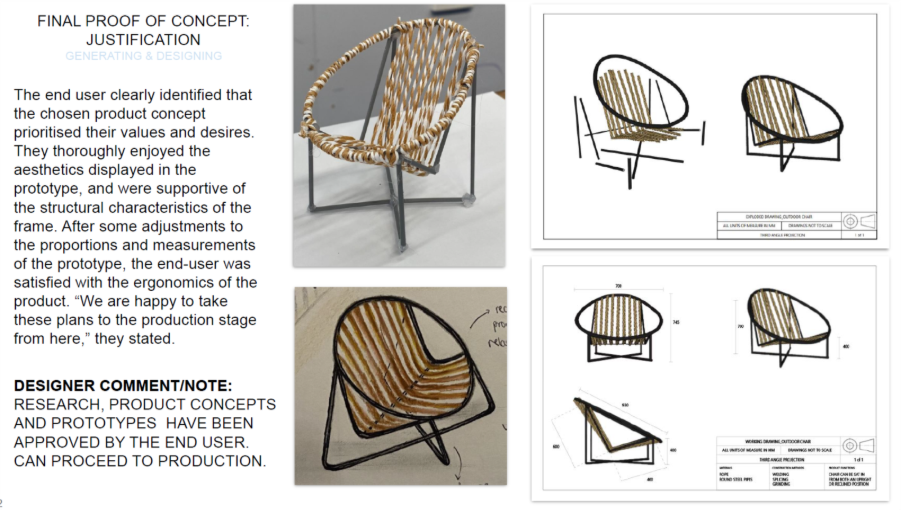
The weaving itself posed to be a problematic process. The handling of heavy spools of rope made the process awkward and straining, whilst also being very time consuming (I’m not very strong myself so I needed a hand for this stage). Since I had never weaved with rope before in such a way that it was to be weight bearing, it also took several attempts of different weaving patterns and product tests to find which way was most suitable. Unweaving each failed attempt was the most difficult experience by far.
What skills did you develop as the project progressed?
The skill which I found most excitement in learning was welding. I was given the opportunity to learn MIG welding and felt myself improve with each tack and thread I did on the chair’s frame. Learning the terminology and different techniques was very fun.
I also learnt the importance of planning and time management, especially when given a tight deadline to complete the construction process. The more precise and specific my plans were, the quicker and easier it was to construct components such as the frame.
Now that you’ve finished high school, how are you using the skills you developed in Product Design? Is it related to what you're studying now?
Currently I am completing an Advanced Diploma of Building Design at RMIT. This course is very content heavy, so the planning and time management skills I developed has definitely helped me as I start the new Semester. The exposure to different materials, their use and different grades has also transitioned nicely into this course, giving me a head start on some of the more practical aspects of assignments. I’ve also learnt the importance of the ‘human experience’ and biomechanics in relation to design (considering I was making a chair that humans were to directly interact with) - this has also given me insight whilst I design spaces.
What advice would you give current students considering Product Design?
Try something new! I always thought product design was centred around timber-based products, but there is so much else you can work with. The more different materials you try to work with, the more confident you will feel, not only working with tools and machinery, but also when interacting with other products and understanding the way things work/are made. Just ask the teachers to show you!
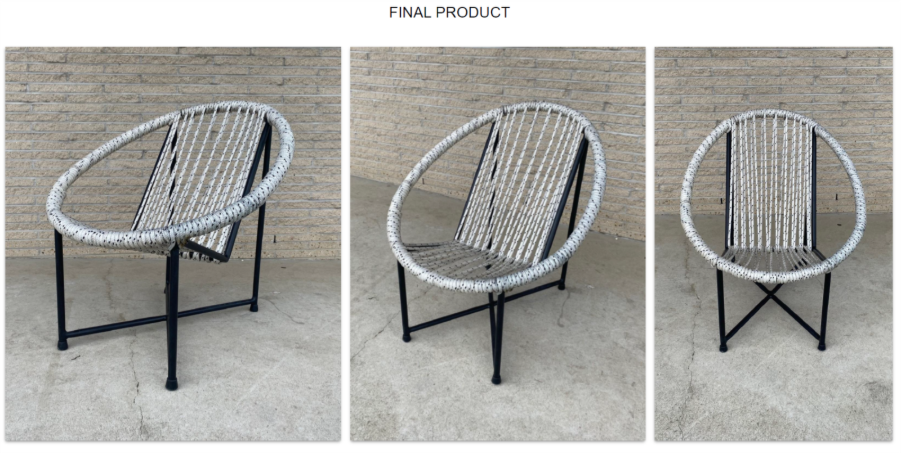
Stella’s work is a reminder that good learning is rarely neat or straightforward. It takes trial, error, patience and a bit of grit. We are proud of the standard she achieved and even more proud of the determination behind it. Well done Stella, and all the best for your future studies.
Jade Smith
Deputy Principal - Learning & Teaching