
Principals Report
Principal's Report
Principal’s Message
As we come to the end of Term 1, it provides a wonderful opportunity to pause and reflect on what has been a positive and busy start to the year. It’s hard to believe that our Prep students are already a quarter of the way through their first formal year of schooling and have shown such wonderful growth. At the other end of the school, our Year 6 students will soon begin transitioning to secondary school—a reminder of just how quickly time moves in a school community.
As we head into the Easter school holidays, I hope all families find time to slow down, take a breath, and enjoy this special time together.
On Sunday, the microphone wasn’t working in the “crying room” at Mass—where I was sitting—so I didn’t hear Fr Junjun’s message about Palm Sunday. What I can speak about, however, is the beautiful opportunity our children have enjoyed each Sunday morning during Lent through Children’s Liturgy, generously led by Nat Crummy. Seeing the Gospel explained in such a meaningful and age‑appropriate way for our young students is a gift. I know family life is busy, but I cannot recommend strongly enough the nourishment and joy our family experiences through attending Mass together each week.
It was also wonderful to see our community come together on Thursday to celebrate Purple Up for Epilepsy Day. If you haven’t already, be sure to grab a copy of the Yarrawonga Chronicle—Jaxon is an absolute star! I heard many positive comments about the energy, participation, and strong sense of solidarity across the school.
Last week, I attended a Principals’ Conference and had the privilege of hearing from several outstanding speakers, including Gilbert Enoka (All Blacks Mindset Coach), Dr Preeya Alexander (GP and paediatric health expert), Dr Justin Coulson (parenting and resilience expert), and Peter Merrett (award‑winning luxury hotelier) to name a few. I’ve shared my notes and reflections from these keynotes at the end of this newsletter and would be more than happy to chat with anyone interested in the learning I took away from these sessions.
The Big Water Walk – Thursday 2 April (Last Day of Term 1)
As part of our Lenten fundraising, we will hold The Big Water Walk (formerly Caritas Ks). This meaningful day helps our students develop awareness of the challenges faced by others while raising funds for important causes.
Schedule:
· 9:45am – Liturgy
· 11:15am – Laps begin
· 12:45pm – Whole‑school lunch
· 2:15pm – Early dismissal
Final Days of Term
We have an enjoyable last few days of Term 1 ahead. On Wednesday, our Year 5/6 students attended Backflips Against Bullying at Sacred Heart College. We will conclude the week—and the term—by celebrating Holy Thursday together with a liturgy at 9:45am, followed by the Big Water Walk at 11:15am and a shared lunch in the schoolyard at 12:45pm. Students will be dismissed early at 2:15pm.
I would like to sincerely thank all parents for your support and partnership throughout what has been a busy and rewarding first term. Highlights for me have included our Opening School Mass, Swimming Carnival, Year 4 Camp to Mt Feathertop, and Ride to School Day, just to name a few. I hope your children have made wonderful memories and that you have seen their growth academically, socially, and spiritually.
Thank you also to families who use the drive‑through pick‑up zone outside the front office. Waiting until approximately 3:13–3:14pm before arriving has significantly improved traffic flow and helped reduce congestion around Woods Road, Orr Street, and the roundabout. Staff supervise the area from 3:15pm to approximately 3:30pm, or until all students are collected, so there is no need to arrive early.
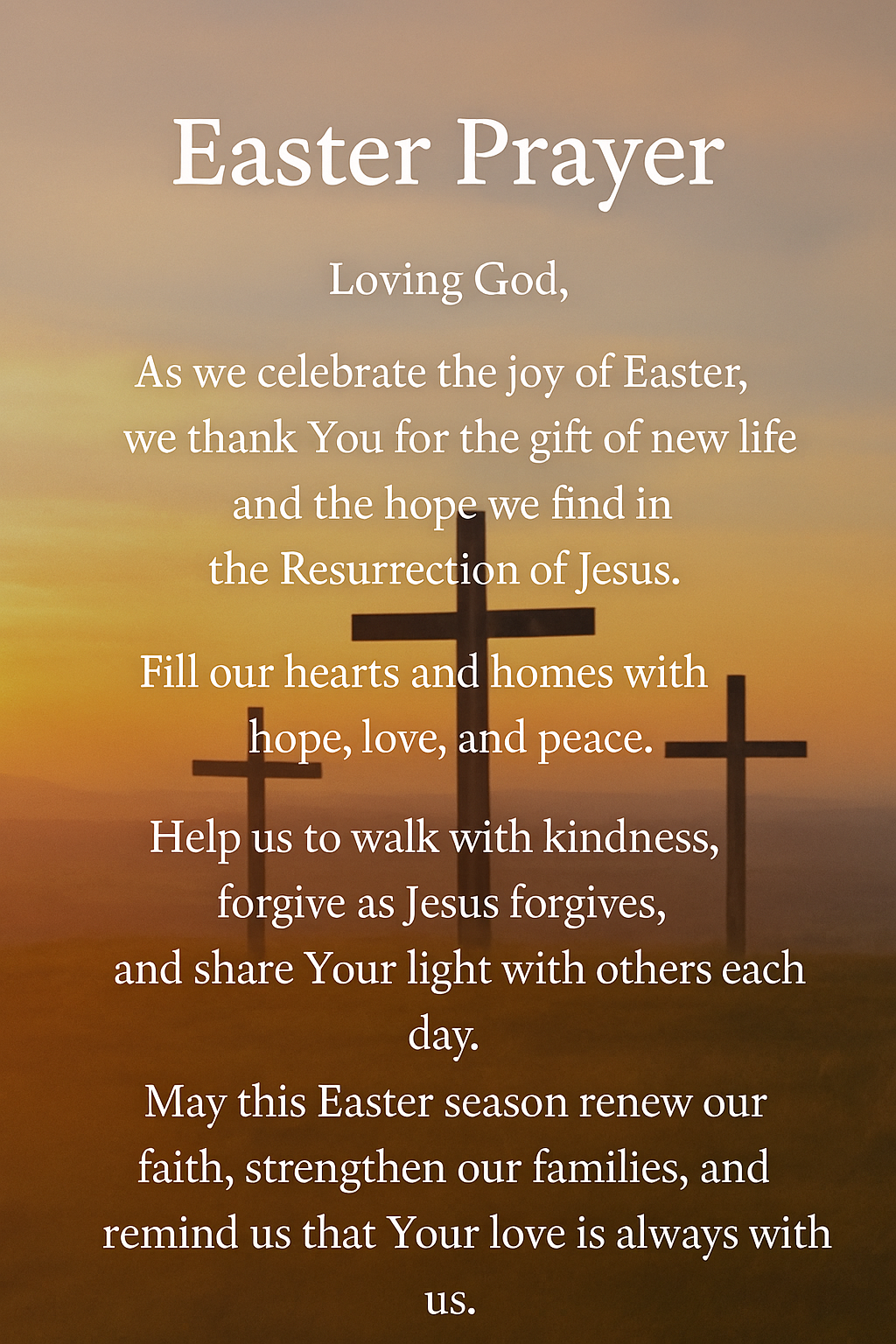
Easter – A Time of Faith and Renewal
As we enter the Easter holidays, we pause with the wider Church to reflect on and celebrate the life, death, and resurrection of Jesus. Easter is the heart of the Church’s year and holds
deep significance for us as a Catholic primary school community. It invites us to reconnect with what truly matters—faith, hope, forgiveness, and new beginnings.
As children learn about the Easter story at school, families are encouraged to continue these conversations at home, helping students understand that Easter is not just a historical event but a living message of hope and renewal. It reminds us that light follows darkness and joy comes after hardship.
I wish all families a safe, holy, and joyful Easter break. We look forward to welcoming students back to school on Tuesday 21 April.
Take care, and God bless.
Jarrod
Term Dates for the Year:
TERM 1: January 27 to April 2
TERM 2: April 20 to June 26
TERM 3: July 13 to September 19
TERM 4: October 5 to December 18
2026 VACPSP Conference – Jarrod's notes
Dr Preeya Alexander
Dr Preeya Alexander is a Melbourne‑based general practitioner, paediatric and women’s health expert, medical educator, author, and media commentator known for breaking down complex health information to empower families and communities.
Preeya’s key message centred on the direct relationship between our physical health and mental wellbeing. She spoke extensively about diet, exercise, and sleep.
She reminded us that we all require two serves of fruit and five serves of vegetables daily, and shared that numerous recent studies have identified a link between ultra‑processed foods and higher rates of depression. Preeya emphasised the importance of food familiarity for young children, noting that even if a child simply touches the food on their plate, this should be considered a win.
She spoke about the dangers of “diet culture” and the messages this can send to children, cautioning against assigning “good” or “bad” labels to food. Food is fuel for our bodies, and it is essential that we provide the right fuel to support growth and wellbeing.
Preeya also highlighted the importance of physical activity, stating that children should engage in at least 60 minutes of movement per day (with more being even better). Physical activity
supports both body and brain health. She shared the concerning statistic that around age 14, girls disengage from team sports at double the rate of boys.
She also explained that recurring tummy aches in children are often a somatic complaint, as children may struggle to verbalise emotional concerns, which can then present as gut-related symptoms.
Sleep was another major focus. Preeya stressed the importance of a regular wind‑down routine and recommended that all bright lights and screens be turned off one hour before bedtime.
She concluded by noting that this year the flu vaccine will be available intra‑nasally (flu mist).
Dr Justin Coulson
Dr Justin Coulson is a best‑selling author, parenting and resilience expert, and psychologist best known for his work on raising emotionally healthy children and families.
Justin began by introducing the Motivation Continuum, explaining that motivation does not sit solely at two extremes—external (avoiding punishment or gaining rewards) and intrinsic (doing something because we love it)—but rather exists along a continuum.
He outlined the stages:
· External motivation – driven by rewards or consequences
· Introjected motivation – doing something because we feel we have to
· Identified motivation – doing something because we see its value
· Integrated motivation – behaviour aligned with our identity
· Intrinsic motivation – the deepest and most sustainable form
Justin explained that external motivation is the weakest form, as rewards only motivate people to obtain the reward. To move children towards intrinsic motivation, adults must support three key psychological needs:
· Competence – providing structure, support, and guidance so children feel capable of mastering tasks
· Relatedness – building trust and connection; Justin noted that it takes just one peer who says “come and sit/play with us” and one teacher whose eyes light up when they see a child to foster connection
· Autonomy – giving children a sense of choice and ownership; in schools, this means students understand what they are doing, why it matters, and that the choice to engage is meaningful
Justin concluded by reminding us that children ultimately want to feel seen, heard, valued, and connected.
Peter Merrett
Peter Merrett is a respected luxury hotelier, known for his leadership in developing and operating premium hotels and resorts, with a strong focus on design excellence, guest experience, and long‑term asset value.
Peter spoke about the importance of making people feel genuinely welcome. In the luxury hotel he managed, daily staff briefings were used to create personalised guest experiences.
He shared a story about Mr and Mrs Smith, who were returning to the hotel for the third time in ten years—this time to celebrate their 50th wedding anniversary. Because staff were prepared with this information, guests were welcomed with, “Welcome back, Mr and Mrs Smith, it’s wonderful to see you again,” rather than generic greetings. Peter highlighted the power of language in creating belonging.
He encouraged us to slow down in order to speed up, referencing the importance of intentional thinking (the “5 T’s”). He stated that the deepest human desire is appreciation.
Peter also shared a personal story about his young sons lining up to meet Santa. After waiting 20 minutes, they were told they were in the wrong line and had missed their chance. While not angry with the staff member, Peter explained this moment showed the importance of understanding perspective. For staff, Santa may meet hundreds of children; for each child, it is a once‑in‑a‑lifetime experience. What should be said instead is, “Santa has been waiting all day for you.”
He concluded by reinforcing that we all want to feel seen, heard, and appreciated.
Gilbert Enoka
Gilbert Enoka is a renowned sports performance consultant and psychologist, best known for his long‑standing role in shaping the winning culture and mental resilience of the New Zealand All Blacks.
Gilbert opened by stating that experience without reflection hardens us rather than grows us, and that information alone does not lead to transformation. He emphasised that we can never rise above the opinions we hold of ourselves and encouraged us to discard beliefs that no longer serve us.
Key messages included:
· Choices, not chances, determine our destiny
· We can give in, give up, or give it everything we’ve got
· Our past does not determine our future—don’t trip over what’s behind us
Gilbert spoke about the importance of mindset, skillset, and structure. While mindset and skillset are vital, they are ineffective without the structure and discipline to sustain them.
He explained that when emotions run high, we need to steady the mind, shrink the moment, and identify the next small step. He also reminded us that everyone carries an invisible backpack filled with pressures—family, work, finances, social media, and expectations—and we must remember others are carrying theirs too.
He noted that we can’t improve what we don’t talk about, adding that there are only two ways to do something: the right way and again. He shared the phrase, “Love needs action, trust needs proof, and sorry needs change.”
Gilbert concluded with the All Blacks’ “sweep the sheds” philosophy—a reminder that humility matters and we should always leave places better than we found them.
Dr Yemi Penn
Dr Yemi Penn is a globally recognised engineer, researcher, keynote speaker, and thought leader whose work focuses on curiosity, trauma‑informed leadership, and cultural transformation.
Yemi repeatedly emphasised the importance of responding to people and situations with grace and kindness, noting that “life will life us”—it can be unpredictable and challenging.
She spoke about the importance of flexibility to allow us to influence our environment and encouraged us to deconstruct belief systems that no longer serve us.
Raymond Friel OBE
Raymond Friel OBE is a respected Catholic education and social justice leader, author, and speaker, currently serving as CEO of the Caritas Social Action Network.
Raymond spoke about interconnectedness, reminding us that we are all in it together. He emphasised that Catholic leaders must support people’s head, heart, and hands, likening this to the Wizard of Oz:
· The Scarecrow needed a brain
· The Tin Man needed a heart
· The Lion needed courage
He stressed the need for love in leadership, noting that without it:
· Innocence can lead to cynicism
· Curiosity can lead to arrogance
· Compassion can lead to callousness
Raymond highlighted the importance of discernment, encouraging leaders to See, Discern, then Act. He spoke about the value of silence and stillness and noted that Catholic Identity Leaders often act as the Chief Reminding Officer, continually drawing others back to values, vision, and mission.
He concluded by reminding us to be fully present with the person in front of us. Referring to Pope Francis’s warning about the “rapidification” of the world, Raymond encouraged us to become experts in encounter.