
Principal's Report

School Wide Positive Behaviour Support
BUILDING RESILIENCE
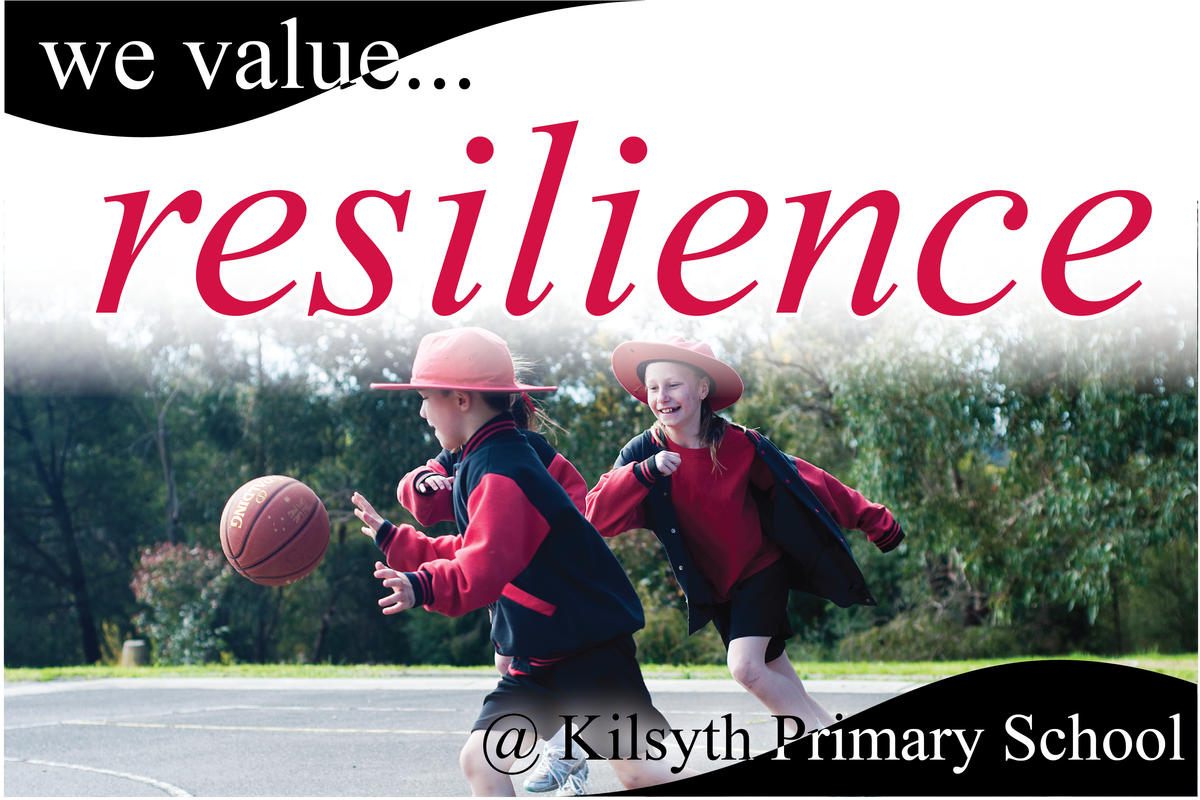
This term as part of our School Wide Positive Behaviour Support approach we are exploring our school value of RESILIENCE. Each week students undertake at least an hour explicitly learning about resilience and developing strategies to support them in building their own resilience. In coming weeks every child in the school will take part in an online video conferencing webinar with an expert from Kids Helpline. This promises to be a great learning opportunity for our students.
The following article comes from the beyondblue.org.au website and provides a great overview of resilience and how you as parents can support your child in developing resilience at home. You can read the full article here.
Building resilience in children
Resilience … it’s a familiar word, isn’t it? But what does it really mean?
When we talk about resilience, we’re talking about a child’s ability to cope with ups and downs, and bounce back from the challenges they experience during childhood – for example moving home, changing schools, studying for an exam or dealing with the death of a loved one. Building resilience helps children not only to deal with current difficulties that are a part of everyday life, but also to develop the basic skills and habits that will help them deal with challenges later in life, during adolescence and adulthood.
Resilience is important for children’s mental health. Children with greater resilience are better able to manage stress, which is a common response to difficult events. Stress is a risk factor for mental health conditions such as anxiety and depression, if the level of stress is severe or ongoing.
So where does resilience come from?
Resilience is shaped partly by the individual characteristics we are born with (our genes, temperament and personality) and partly by the environment we grow up in — our family, community and the broader society. While there are some things we can’t change, such as our biological makeup, there are many things we can change.
One way of explaining the concept of resilience is to imagine a plane encountering turbulence mid-flight. The turbulence, or poor weather, represents adversity. Different planes will respond to poor weather conditions in different ways, in the same way different children respond to the same adversity in different ways.
The ability of the plane to get through the poor weather and reach its destination depends on:

- the pilot (the child)
- the co-pilot (the child’s family, friends, teachers and health professionals)
- the type of plane (the child’s individual characteristics such as age and temperament)
- the equipment available to the pilot, co-pilots and ground crew
- the severity and duration of the poor weather.
We can all help children become more resilient and the good news is, you don’t have to do it alone. You can ask other adults such as carers and grandparents to help. Building children’s resilience is everyone’s business, and it’s never too early or too late to get started. We’ve got some simple things that you can do in your own home.
How can I build resilience in my child?
Our latest research found that there are five areas that offer the best chance for building resilience in children.
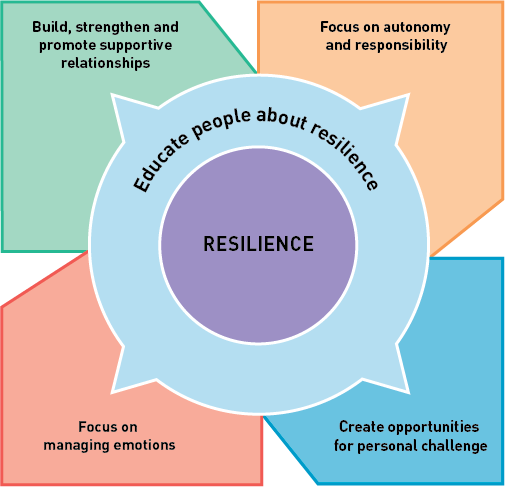
As a parent, carer, or significant adult, you can help to develop essential skills, habits and attitudes for building resilience at home by helping your child to:
- build good relationships with others including adults and peers
- build their independence
- learn to identify, express and manage their emotions
- build their confidence by taking on personal challenges
There are some simple things you can do to build your child’s resilience in these areas (click on the links above). You might be able to think of more.
It’s important to remember that the strategies we recommend:
- are suitable for everyday use with children aged 0–12 years
- have been tailored for pre-school aged children (1–5 years) and
- primary school aged children (6–12 years)
- should be prioritised in a way that best meets your child’s needs.
If your child is currently experiencing stress, challenges or hardships in life which are affecting their wellbeing, additional professional support may be necessary.
WORKING BEE TOMORROW - PLANTING!

Don't forget our working bee tomorrow! We will begin at 8.30am and will be planting out some new garden beds. Please bring gardening tools if you have them. We would love to see you there. Many hands make light work!!
Welcome to George McDonald
We are pleased to welcome Mr George McDonald to our school council in a community member role. George is an active member of the Kilsyth Community Action Group and has been a significant member of the Kilsyth community for many years. We are pleased to have George on board sharing his networks and wisdom as part of our school council. George came along to our recent Twilight School and sent me the following email. It was wonderful to hear how education has changed over the years and I thought I would share it with you:
Hi! Daniel & Kristy,
Thank you ever so much for the guided tour around the school and the
opportunity to visit the active classrooms and meet with many of your Staff
in action, observing to me, such a difference in how I remember Primary
Schooling.
Reflecting on my first two years prior to the start of world war 2, when we
used Sand Trays and a stick like pencil to draw the ABC's & 123's in the
sand, instead of Paper & Pencil, if you were wrong the teacher would
just shake the Sand Tray to make the surface level again ready for your
next attempt.
Amazed at the team work with the Sausage Sizzle, Number of Sausages
200 or so? cooking time to hot oven 1 hour 7 minutes, delivery time less
than 11 minutes. "A big Thank You" to Kristy and the Volunteers.
It opened my eyes to just how big the school was and what an ideal
environment the school is set in, with a Good Sized Oval with lovely
views all around.
A privilege to be a part of such a fine School, well structured and with
a management council with excellent vision, values and sound practical
objectives to improve and provide all round welfare for the Pupils.
Don't be afraid to invite me to your "Working Bee's" or extra staffing
requirements for major school functions or Sports Days.
Having been the launching Chairman of the Mountain District Stadium
Co-operative Ltd. in 1969, who over saw the building of the first stadium at
the Kilsyth Sports Centre, (3 Badminton Courts), then going on to develop
it to 6 courts in 1977, then to 12 courts in 1980, finally retiring in 2015 when
the Council bought out our share and took over total control.
So I have had a sound background in being part of a wonderful WB Trades
Team involving about 40 people Men and Women who built, maintained,
painted and improved the Badminton Stadium over a period 1972 to 2015
some 43 years.
Sincere regards,
George.
Annual Report to the School Community
The annual report to the school community for 2017 has been endorsed by school council and is now available. You can download it here:
Semester One Reports - Are you on Sentral?
This semester we will be distributing our student reports online via our Sentral Parent Portal. All families should have received instructions earlier this year on how to register for and login to Sentral. Miss Karen Donnelly will be offerings support sessions over coming weeks to help those who are yet to get connected up and running.
Semester One student reports will be released via Sentral on Wednesday 27th June. You will be able to access your child's report online from 2.30pm on this day. Support sessions and access to computers will be provided on both the 27th and 28th June to help you access your child's report should you need it.
Hardcopies of student reports will be available upon request after the 18th July. More information and 'How to' documentation will be made available soon.
HAVE A GREAT WEEKEND!